
Sales automation implementation cost depends on the process you are buying, the systems it touches and the evidence required to accept it. A subscription buys access to software. It does not, by itself, define your routing rules, repair source data, test exceptions or assign someone to resolve a failed integration.
For a Saudi or GCC B2B team comparing proposals, the useful starting question is: Which business event must produce which verified result, under which conditions? A quote becomes comparable when those boundaries are written down.
This guide provides a scope worksheet, a cost model and an acceptance matrix you can use before approving work. It does not give a market price range or imply that every integration is available in every account.
The executive decision: buy a tested outcome
Before comparing totals, confirm five things:
- The workflow has a named starting event and a defined end state.
- Each transferred field has a source, destination and editing owner.
- Normal, duplicate, incomplete and failed events have expected outcomes.
- Software, implementation, usage and ongoing support are priced separately.
- Someone can prove the result, stop the workflow and recover pending work.
If a proposal says only “connect the CRM and automate follow-up,” request clarification. Two suppliers may be pricing different responsibilities, even when the list of applications is identical.
What is included in sales automation implementation?
Sales automation implementation is the work of turning an agreed sales process into configured, tested and documented behavior across the relevant systems. Its unit of value is a usable business outcome, such as a valid inquiry reaching the correct salesperson with the right context.
An implementation may include discovery, field mapping, configuration, available integrations, exception handling, testing, training and handover. A custom connector, historical migration, platform replacement or ongoing operations is included only when explicitly scoped.
Solvarex's sales workflow and CRM integration service describes process mapping, supported connections, testing and operational handover. If the primary need is pipeline design or record migration, compare the separate CRM implementation scope as well. Selecting the software and implementing the process are related decisions with different deliverables.
Write one workflow scope card before requesting a price
Use the following worksheet for each important flow. The entries are planning prompts, not a promise that a particular platform supports every behavior.
| Scope item | What to document | Why it changes the quote |
|---|---|---|
| Business outcome | Valid consultation inquiry assigned and visible in CRM | Defines the end of delivery |
| Trigger | Exact form, event or approved status change | Distinguishes one source from many |
| Eligibility | Required fields, exclusions and channel conditions | Determines branches and review paths |
| Records | Contact, company and opportunity objects involved | Prevents a hidden migration project |
| Field ownership | Who supplies and may overwrite each value | Makes conflicts testable |
| Connection | Available connector, API or approved import | Separates known access from assumptions |
| Failure response | Retry, alert, review queue and recovery owner | Defines operational responsibility |
| Acceptance | Test input, expected output and approving person | Makes completion demonstrable |
| Exclusions | Old records, extra channels, custom development | Protects the agreed boundary |
Attach sanitized examples of a valid event and an awkward one. A screenshot of the desired final screen is useful, but it does not replace the rules that produce it.
Example: an inquiry arriving twice
An illustrative workflow receives a website inquiry, checks whether the relevant record already exists, applies an agreed ownership rule and creates a follow-up task. The form provider sends the same event again after a connection interruption.
The business requirement should say whether this is a duplicate delivery of one inquiry or a genuinely new inquiry from the same person. Those situations may need different outcomes. “Deduplicate by email” is not a complete policy for shared mailboxes, changed addresses or several legitimate opportunities.
Keep event identity, person identity and opportunity identity separate. The acceptance check should prove that repeating the same event does not create an unwanted second task while a valid new request remains visible. For broader record cleanup, use the CRM data quality guide rather than quietly adding unlimited cleanup to an integration quote.
The six cost drivers that matter more than the number of apps
1. Process decisions and exceptions
A single pipeline with one owner rule is different from several business units with account protection, reassignment and absence coverage. Count the decisions that require agreement, not just the boxes drawn in a workflow builder.
If the sales team cannot agree who owns an existing customer, the blocker is an operating decision. Automating both interpretations creates a faster conflict. Resolve the policy or mark it as an explicit dependency.
2. Data readiness and matching
Inconsistent fields, missing IDs and conflicting company names can require preparation before integration. Ask whether the price covers a small test sample, a defined production batch or continuing remediation.
For bilingual teams, specify how Arabic and English names are stored and searched. Do not assume two spellings prove two companies. Preserve the original values and use an agreed matching policy instead of silently rewriting identity fields.
3. Connection feasibility and account entitlements
A visible integration logo does not prove that the required event, object, direction or account tier is supported. Ask for evidence from the actual accounts and current documentation. Record who grants access and whether a test environment exists.
Microsoft's Power Automate limits documentation illustrates why capacity must be checked: request limits depend on licensing, individual connectors have limits, and retries consume requests. These are platform-specific facts, not universal limits for every automation tool.
4. Recovery and monitoring
A successful demonstration covers one path. Production operation also needs an answer for expired access, missing information and interrupted connections. Define which problems can be retried and which require a human decision; blindly repeating an invalid record is not recovery.
Microsoft's error-handling guidance documents alternative failure paths, retry policies, logging and notifications. Use the relevant capabilities of the chosen system; do not assume every connector offers the same controls.
5. Testing and acceptance evidence
Testing becomes more substantial when a process has permissions, languages, calendars, multiple owners and irreversible downstream actions. A buyer should agree on the critical scenarios before implementation, then require recorded results.
The Microsoft Power Platform performance-testing guidance recommends translating performance targets into acceptance criteria and testing realistic usage. Your actual thresholds must come from your business needs and verified system capacity, not an arbitrary number copied from a blog.
6. Handover and continuing change
Clarify whether the deliverable includes an editable map, configuration inventory, operating instructions and training. Name the owner for credentials and future changes. A workflow tied to a departing employee's account can become an avoidable operational dependency.
Post-launch observation, incident response and enhancement work have different purposes. State their duration, scope and commercial basis separately. “Support included” is too vague to compare.
A transparent cost model, with an illustrative SAR example
Use this planning equation:
First-year cost = implementation + subscriptions and usage + agreed support + approved change allowance.
The following invented numbers explain the arithmetic. They are not Solvarex prices, Saudi market rates, a quotation or promised project effort. Tax treatment and any applicable taxes must be addressed separately in the actual proposal.
| Illustrative item | Assumed amount |
|---|---|
| Discovery and process specification | SAR 4,000 |
| Configuration and agreed connections | SAR 10,000 |
| Testing, documentation and training | SAR 4,000 |
| One-time implementation subtotal | SAR 18,000 |
| Assumed combined software and usage budget: SAR 600 × 12 | SAR 7,200 |
| Assumed support: SAR 500 × 12 | SAR 6,000 |
| First-year subtotal before change allowance and taxes | SAR 31,200 |
| Separate illustrative change allowance | SAR 3,000 |
| Planning total including allowance, before taxes | SAR 34,200 |
The allowance is a planning provision, not automatically earned supplier revenue. Define the approval process before using it. Also list subscription commitments, included usage and what happens above the allowance; a monthly estimate is not a guaranteed cap.
To compare proposals, put each offer against the same scope card and ask which line pays for each responsibility. A lower implementation fee can still produce a higher total if important work or recurring charges are excluded.
Acceptance tests: what “working” should mean
Acceptance criteria are the agreed conditions used to decide whether a deliverable is complete. They should connect a business scenario to visible evidence, rather than simply asking whether the automation is switched on.
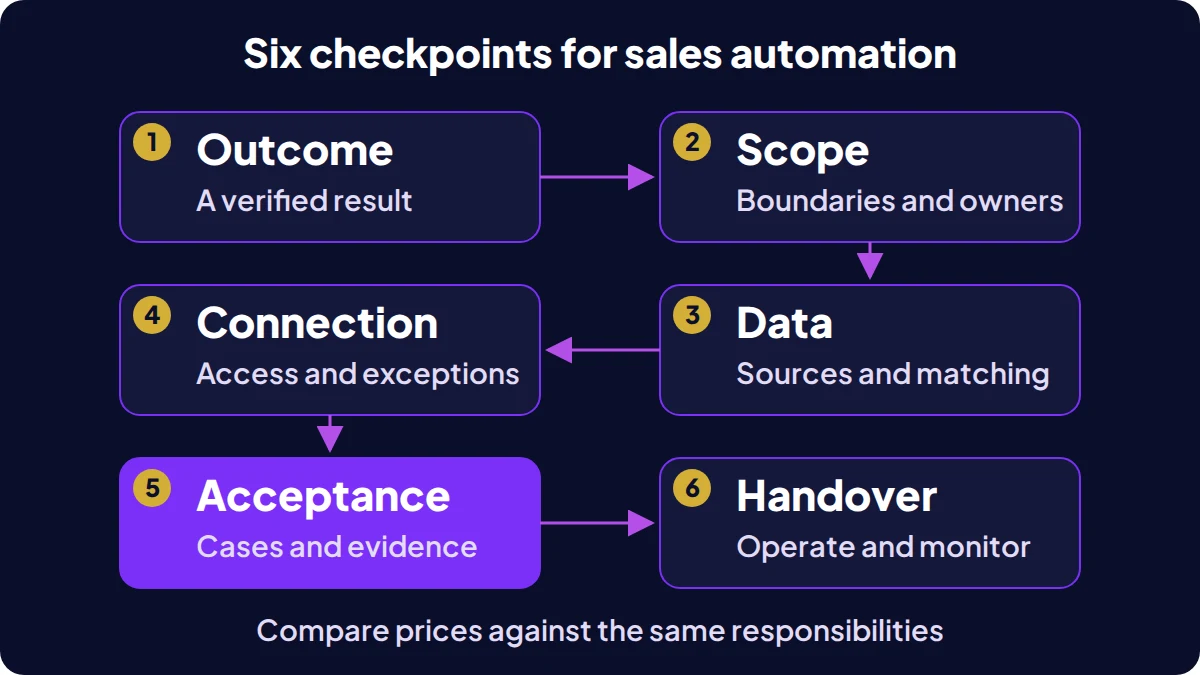
This example matrix is a recommended planning framework. Adapt it to the actual tools and risk level.
| Scenario | Expected result | Evidence to retain |
|---|---|---|
| Valid inquiry | Agreed fields arrive and correct owner is assigned | Input reference, destination record and timestamp |
| Same event repeated | No unintended duplicate record or task | Event reference and before/after records |
| Required value missing | Review path runs; no false completion | Review item and responsible owner |
| Temporary connection failure | Agreed retry or recovery path is visible | Run outcome and recovery record |
| Conflicting update | Agreed source wins or conflict is reviewed | Field map and resulting value |
| Restricted user | Only permitted records and actions are accessible | Test account and observed access |
| Arabic inquiry and mixed-format phone | Original text and agreed normalization survive | Sample input and stored result |
| Workflow paused | New intake and pending work follow the documented policy | Pause check and queue disposition |
Specify the timezone for timestamps and the business calendar for response commitments. If a Riyadh team and a Dubai colleague share ownership, document each team's actual working hours and absence cover. Never infer an individual company's calendar from its country.
For a sales response commitment, distinguish system processing time from a person's first useful response. The lead-routing SLA guide covers ownership and escalation; this article focuses on how those requirements become a priced, accepted implementation.
Launch in stages, with an accountable handover
Start with a narrow, useful process and a controlled sample. Validate its expected outcomes before enabling a larger audience or additional sources. Agree on how to stop new activity and how to inspect work already in progress; switching a flow off must not be assumed to undo completed actions.
At handover, retain:
- The approved scope and its explicit exclusions.
- The field map, trigger conditions and ownership rules.
- Test results, open issues and acceptance decision.
- Access ownership and configuration inventory, without exposed secrets.
- Monitoring responsibilities, escalation contacts and recovery instructions.
- A change log and the process for approving additional work.
Read the CRM implementation readiness guide if the broader pipeline, team permissions or launch ownership is still undecided. A workflow project should not conceal an unplanned full CRM replacement.
Measure whether the process helps sales
Track successful business outcomes as well as technical executions. For example, distinguish received events, eligible inquiries, correctly assigned records, unresolved exceptions and completed follow-up. Several technical steps can belong to one inquiry, so an action count is not a lead count.
Measure manual handling using comparable samples and a stated observation period. Time saved is not automatically revenue, and a booked meeting is not automatically a qualified opportunity. For meeting quality and sales acceptance, use the appointment-setting guide.
The first useful review asks where cases stalled, which exceptions needed people and whether the scope assumptions held. Use that evidence to approve the next increment instead of adding more automation because the software permits it.
Questions to ask before approving a proposal
How much does sales automation implementation cost?
There is no defensible single price without the process, systems, data condition, test requirements and support scope. Request an itemized proposal and separate implementation from software and usage. The SAR example above teaches a calculation; it is not a market benchmark.
Does an existing connector make the integration simple?
It may reduce configuration work, but availability alone does not confirm the required objects, direction, account access, capacity or exception behavior. Validate those details in the actual accounts before committing to an outcome.
Can we keep our current CRM?
Possibly. Review its available connections, permissions and data model first. A platform migration is a separate decision; it should not be assumed necessary or included without evidence and agreement.
Who should sign off the implementation?
The business process owner should accept the operational result, with the relevant system owner validating access and technical behavior. Name both responsibilities in advance and agree how unresolved issues affect acceptance.
Are maintenance and future API changes included?
Only when the proposal says so. Separate defect correction within the agreed deliverable from vendor changes, new business rules, added channels and ongoing monitoring. Clarify the actual terms rather than assuming unlimited support.
What should we prepare for a Solvarex consultation?
Bring a sanitized process example, system names, expected monthly volume, known exceptions, access owners and the desired business outcome. Avoid sending passwords or private customer lists. Solvarex can discuss a defined workflow automation scope and the relevant implementation dependencies.
Turn a broad automation idea into an approvable scope
The strongest proposal explains what will happen, where it can fail, how success will be tested and who operates it afterward. That clarity makes cost comparisons useful and protects the sales process from a technically successful but operationally incomplete handover.
To discuss your current systems and a sensible first workflow, book a free Solvarex consultation. Bring the scope card above; agree on feasibility, responsibilities and acceptance before selecting the implementation package.