
A lead routing SLA is an internal operating agreement that defines who owns a new sales inquiry, when a meaningful first response is due, and what happens if assignment or follow-up fails. It joins marketing, sales and operations around a measurable process. A notification alone is not ownership, and an automated receipt alone is not a sales response.
For B2B teams serving Saudi Arabia and the GCC, the practical challenge can include Arabic and English inquiries, product specialists, existing account relationships and different staffed calendars. Start by making those decisions explicit. Buying another CRM feature before agreeing the rules can automate ambiguity.
Executive takeaway: give every eligible inquiry one accountable owner, a backup, a documented response deadline and a visible exception path. Measure the journey from receipt to assignment, first action, held meeting and accepted opportunity. Keep deadlines realistic and distinguish operational targets from promises made to buyers.
What belongs in a lead routing SLA?
Lead routing assigns an inquiry to a person or monitored team according to agreed conditions. The SLA adds the timing, acceptance evidence and recovery rules around that assignment. In this guide, SLA means an internal marketing-to-sales agreement; it is not a software uptime commitment or a contractual guarantee to customers.
Use this one-page worksheet before configuring automation:
| Decision | Write down | Accountable role |
|---|---|---|
| Eligible demand | Which inquiry types enter the sales process? | Marketing and sales leads |
| Ownership | Account priority, product, market, language and backup | Sales manager |
| Start event | Receipt timestamp and conditions for eligibility | Operations owner |
| Response | What action counts, and where evidence is recorded | Sales manager |
| Calendar | Staffed hours, time zone, holidays and coverage | Team lead |
| Escalation | Trigger, destination, replacement owner and stop rule | Operations owner |
| Acceptance | Conditions for a held meeting or accepted opportunity | Sales lead |
| Measurement | Denominator, exclusions, source and review cadence | Reporting owner |
This is an editorial planning framework, not a benchmark, certification or account of client results. Copy the table into your own operating document and fill the open decisions before implementation.
Separate receipt, assignment and meaningful response
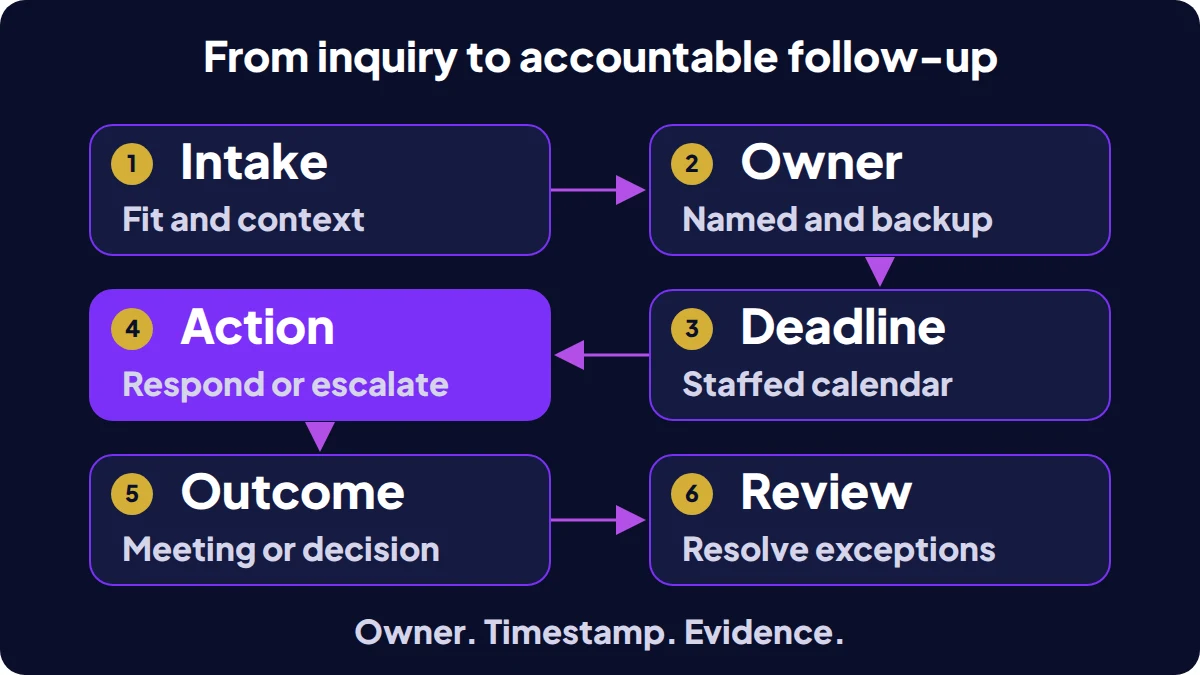
An inquiry may arrive promptly in the website database yet reach the sales representative much later. If the dashboard measures only the time after assignment, that delay disappears. Retain separate timestamps for received, eligible, assigned, first action and outcome, with the rule version used.
Acknowledgement confirms receipt. First meaningful action is a documented, relevant response or contact attempt under your policy. Buyer contact means the buyer actually engaged. A held meeting means the conversation occurred. These are different events and should not share a single “contacted” status.
For example, an automated “Thank you” can acknowledge a quotation request, but it does not show that a specialist reviewed the scope. A logged unanswered call can satisfy an agreed first-attempt target without being counted as a conversation. A booked calendar slot must remain separate from a meeting held and accepted by sales.
Specify which channels count and what evidence is required. If representatives work outside connected channels, agree how they record the action. Keep “timestamp missing” visible rather than converting it to zero minutes. Record both elapsed time from receipt and staffed business time where coverage matters.
Put account ownership before equal distribution
Round robin is useful for sharing eligible inquiries; it does not decide account relationships, expertise or availability. A sensible rule hierarchy begins with existing account or open-opportunity ownership, then checks the relevant product, market and language. Only then distribute work among eligible representatives.
Microsoft's assignment-rule documentation shows why rule order matters: the first matching rule applies. It also distinguishes round robin from workload-based distribution and documents availability settings. These are product-specific behaviors, not a promise that every CRM works the same way.
Use a decision table rather than a collection of competing automations:
| Priority | Condition | Intended route | When the route fails |
|---|---|---|---|
| 1 | Existing account with an active accountable owner | Account owner or agreed coverage owner | Sales manager resolves relationship |
| 2 | Existing open opportunity for the same requirement | Opportunity team under one named owner | Review whether it is a new opportunity |
| 3 | A defined product or specialist requirement | Eligible product team | Monitored specialist exception queue |
| 4 | Market and language requirements | Matching staffed representatives | Coverage owner reviews the gap |
| 5 | General eligible new demand | Agreed round robin or workload rule | Monitored fallback queue |
Validate what “same requirement” means before merging inquiries. One buyer may have several legitimate projects; do not close a new requirement merely because their email address already exists. Equally, do not create parallel sales owners because the same inquiry entered through two channels.
Document account, contact, inquiry and opportunity ownership separately. HubSpot's lead-ownership guidance confirms that lead ownership can be independent of associated contact or company ownership. For any platform, inspect the actual synchronization settings instead of assuming these owners always match.
Set response targets around actual coverage
There is no universal response target that fits every B2B inquiry. Urgent demo requests, technical RFQs, partner applications and low-intent downloads require different actions and resources. Set your initial targets from buyer need, existing response data and staffing, then test whether the team can meet them.
Write the calendar explicitly: time zone, staffed days, daily hours, holidays, absence coverage and any agreed on-call arrangement. Do not copy one country calendar across a regional team. A Saudi team and a UAE team may share a process but need separate coverage records. An Arabic inquiry should not wait silently because the available pool only handles English.
Illustrative policy only: a team staffed 09:00–17:00 on its agreed workdays sets a 60 staffed-minute first-action target for a qualified consultation request. A request received at 16:40 is due at 09:40 on the next staffed day. It still shows its full elapsed waiting time. A submission outside coverage receives an honest acknowledgement and enters the next staffed window. These numbers are examples, not recommendations for every company or a Solvarex service promise.
Measure receipt-to-assignment and assignment-to-action separately. A reassign should not silently reset the original buyer-wait clock. If eligibility waits for necessary information, preserve the original receipt time and report the reason; do not hide processing delays behind a later start event.
Make exceptions a managed work queue
A fallback queue needs a named steward, a deadline and a resolution record. “Assigned to Sales” is incomplete if nobody checks it. Use explicit exception reasons so the weekly review can distinguish weak data from lack of coverage or broken integrations.
| Exception | Immediate handling | Evidence needed to close |
|---|---|---|
| No eligible owner | Route to coverage steward | Named owner and reason |
| Missing routing field | Request only necessary information | Updated field or approved manual decision |
| Duplicate or account conflict | Pause competing follow-up | Surviving inquiry and ownership decision |
| Owner unavailable | Apply agreed backup rule | Replacement accepted the task |
| Connector or workflow failure | Alert operations and retain the inquiry | Replay result and duplicate check |
| First action overdue | Notify owner and supervisor; apply the agreed escalation | Response or approved reassignment |
| Non-sales demand | Route to the appropriate support or administrative team | Destination and clear disposition |
Avoid escalation loops. Give each escalation a state, maximum retry policy and responsible person. Stop pending reminders when a qualifying action occurs, the inquiry closes or an approved human takeover changes responsibility. Replaying a failed event must not create a second task or send the buyer duplicate messages.
The HubSpot rotation documentation describes ownership overwrite choices and situations where rotation can delay processing. Feature availability varies by subscription and record type. Test the chosen workflow in the actual account, including existing owners and integration conflicts; a vendor feature list is not an acceptance test.
Connect routing to meetings and accepted opportunities
Routing succeeds operationally when the right person acts; commercial value requires a further outcome. Agree what sales will accept and why a lead may return for clarification or nurturing. Use structured reasons such as insufficient requirement, wrong service, duplicate inquiry, unsuitable scope, no buyer response or meeting not held.
Keep campaign and channel source on the original inquiry while recording the eventual account and opportunity relationship. When a buyer has several interactions, document your attribution rule. Do not credit every touchpoint with the full opportunity value, and do not label a download as qualified pipeline.
If meetings come from a managed B2B lead generation service, define the handover evidence and responsibility after booking. For conversations entering through AI, the separate chatbot qualification and human handoff guide covers transfer triggers and automation pauses. This routing agreement governs the subsequent ownership, deadlines and reporting across channels.
Build a dashboard with definitions that can be audited
Start with a small number of measures that reveal where demand stalls:
| Measure | Working definition |
|---|---|
| Ownership coverage | Eligible inquiries with a named owner ÷ eligible inquiries |
| Assignment latency | Time from receipt to assignment; show median and slower tail |
| First-action SLA attainment | Due eligible inquiries acted on within their deadline ÷ due eligible inquiries |
| Overdue open demand | Eligible unresolved inquiries whose deadline has passed |
| Exception age | Time since an unresolved routing exception was recorded |
| Held-meeting rate | Meetings held ÷ meetings booked in a stated cohort |
| Sales acceptance | Accepted opportunities ÷ reviewed inquiries under the agreed criteria |
For SLA attainment, include overdue inquiries with no recorded action as failures; excluding them makes performance appear better. Treat missing action evidence as a visible data-quality issue. Report future-due inquiries separately so a deadline that has not arrived cannot count as a miss.
Show both calendar elapsed and staffed-time response measures, with time zones and exclusions. Use comparable received-date cohorts when following demand downstream and note immature cohorts. A higher meeting count does not prove better quality; review accepted opportunities, stage progression and rejection reasons as well. This article makes no claim about Solvarex conversion improvement or measured client outcomes.
Pilot the rules before scaling automation
- Map one real intake path. Identify the source, required fields, identity matching and current delay.
- Approve the policy. Sales and marketing sign off eligibility, owner priority, deadlines, acceptance and exceptions.
- Configure the minimum workflow. Add owner assignment, due date, evidence capture, backup and monitored fallback.
- Test difficult cases. Include existing accounts, two matching rules, duplicate submissions, missing language, absence, holidays, delayed connectors and overdue inquiries with no action.
- Reconcile events. Compare source inquiries with CRM records, assignments, tasks and outcomes; investigate gaps.
- Review a controlled cohort. Inspect misses and exceptions, correct the rules and train the responsible roles before wider rollout.
Write expected and observed results for each scenario. Verify that an existing account is not overwritten accidentally, a repeat event does not duplicate outreach, a coverage gap is visible and a buyer response stops obsolete follow-up. Retain a rule-change record and a way to return to the previous approved behavior.
What affects implementation cost?
Cost depends on intake channels, data quality, identity matching, routing branches, platform limits, calendar logic, integrations, reporting and test scenarios. A single clean form with a small team is a different scope from several markets, shared accounts and bidirectional integrations.
Separate discovery and configuration from ongoing subscriptions, channel usage and monitoring. Request a scope showing fields, rules, exception paths, dashboard definitions, training, acceptance tests and support responsibilities. Adding an automation product does not automatically include every integration or custom reporting requirement.
Solvarex's CRM implementation service covers sales process, fields, roles, migration and training within an agreed project. Its sales workflow and CRM integration service supports defining and testing the connections between steps and systems. Discuss the exact routing and reporting requirements before treating any capability as included. If a wider rollout is planned, use the CRM readiness guide first.
Frequently asked questions
Is a lead routing SLA the same as round robin?
No. Round robin is an assignment method. The SLA adds eligibility, ownership priority, coverage, deadlines, meaningful-action evidence, exceptions and downstream acceptance.
Should an automated reply count as the first sales response?
Record it as acknowledgement. Count it as meaningful response only if the policy explicitly defines the action and its evidence. Do not equate it with human review or buyer engagement.
Should we assign leads by city or by product?
Use the condition that changes responsibility. Product expertise or existing account ownership may take priority over geography. Add a city rule only when coverage, service delivery or territory ownership makes it useful.
What happens when everyone is unavailable?
Send the inquiry to a monitored coverage queue, communicate a realistic expectation and calculate the due date from the approved calendar. If continuous coverage is promised, staff and test that arrangement explicitly.
How do we prevent two representatives contacting the same buyer?
Match the inquiry to existing account and opportunity context, assign one accountable owner, and make duplicate handling visible. Test cross-channel submissions and integration replays rather than relying only on email matching.
Does faster response guarantee more sales?
No. Response speed is one part of a process that also depends on fit, requirement, offer, follow-up and delivery. Measure held meetings and accepted opportunities alongside timing, and compare consistently defined cohorts.
Turn the agreement into a working sales process
The next step is a small, reviewable implementation: one intake path, a clear owner hierarchy, a realistic calendar, a monitored exception queue and measurable outcomes. Expand only when the team can explain what happened to each eligible inquiry.
Book a free consultation with Solvarex to discuss your current CRM and lead follow-up process. Bring a sanitized rule table, staffed calendar and sample field structure. That makes it easier to scope implementation, responsibilities and acceptance criteria around your actual sales operation.