
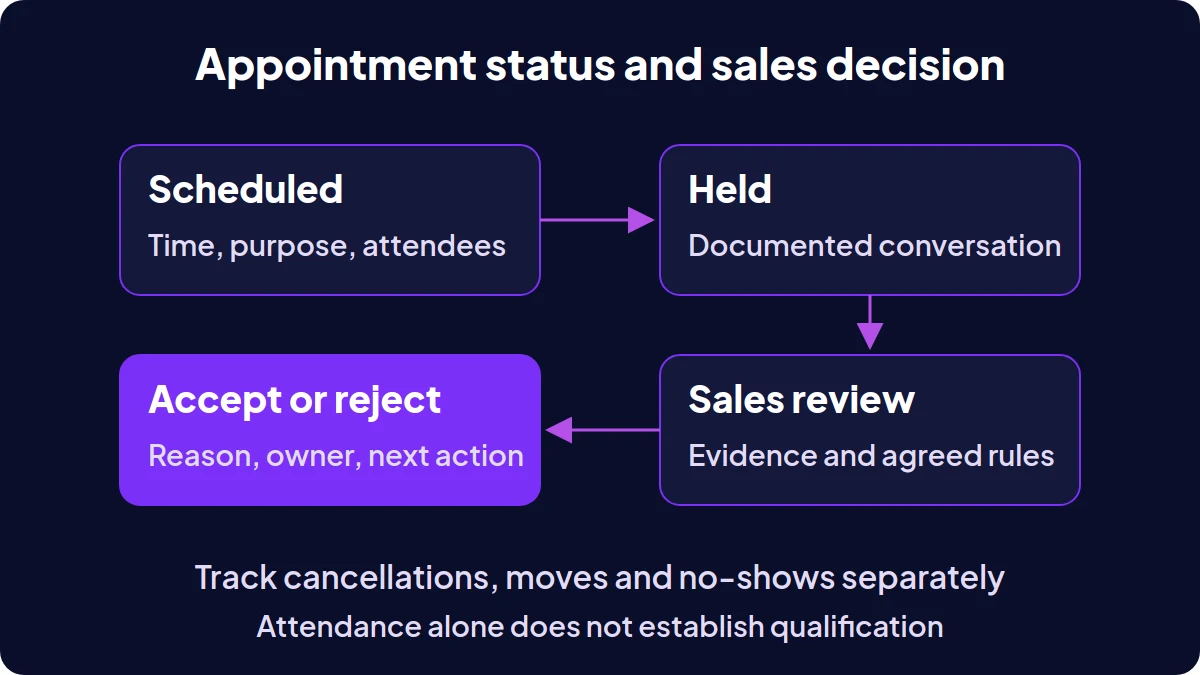
B2B appointment setting is the process of turning a relevant business conversation into a scheduled sales discussion with a clear purpose, appropriate participants and useful context. A booking is only the first outcome. Attendance shows that the conversation happened; sales acceptance shows whether the receiving team considers it worth progressing against criteria agreed in advance.
For Saudi and GCC teams buying a managed service, this distinction matters before comparing proposals or setting monthly targets. A calendar can fill while sellers receive the wrong accounts, incomplete briefs or repeated conversations with the same buyer. The practical objective is to create meetings that sales can prepare for, assess fairly and move toward a justified next step.
Key takeaway: agree what qualifies before outreach, preserve one meeting history through rescheduling, separate attendance from sales acceptance, and use recorded evidence to improve the program. The framework below is an operating recommendation, not a universal industry standard or a promise of results.
What counts as a qualified B2B meeting?
A qualified meeting is a discussion with an account and participant who meet your agreed minimum conditions, have expressed a relevant reason to talk and understand the proposed agenda. Qualification is specific to the offer and sales stage. A discovery meeting need not carry the same evidence as a technical evaluation or procurement discussion.
Write the minimum conditions with the receiving sales team. For example, an IT provider might accept a first discovery meeting when the company matches its target segment, the participant owns or influences the relevant process, a specific problem is stated, and the participant agrees to explore it. Budget may be unknown at this stage; record that fact rather than inventing a number. If confirmed budget is mandatory for this campaign, an unknown budget fails that agreed gate.
Use BANT as a question structure, covering budget, authority, need and timing. Do not turn unanswered questions into positive answers. A procurement title alone does not prove authority, and a verified business email does not prove interest. For the broader sourcing and qualification process, see managed B2B lead generation.
Keep booking, attendance and acceptance separate
Use separate fields for separate decisions. Appointment status answers what happened to the scheduled event. Qualification and sales review answer whether the opportunity meets your commercial conditions.
| Record | What it establishes | Evidence to retain |
|---|---|---|
| Scheduled | A time and meeting purpose were agreed | Appointment ID, participants, time zone and agenda |
| Confirmed | Confirmation was recorded under your policy | Confirmation method and timestamp |
| Held | A substantive conversation took place | Attendance outcome and brief notes |
| Sales accepted | Sales reviewed the held meeting against the agreed criteria | Reviewer, decision, reason and next action |
| Opportunity created | Your opportunity-entry conditions were satisfied | Deal owner, stage evidence and review date |
A confirmed appointment is not automatically a held meeting. A held meeting is not automatically qualified. A sales-accepted meeting is not revenue. Make those distinctions visible in reporting rather than hiding them in one label such as “successful appointment.”
Agree a one-page meeting acceptance contract
Before launching outreach, complete an internal operating brief with sales and the delivery team. It can sit in your CRM documentation; it does not replace the signed commercial agreement.
- Account fit: included sectors, company characteristics, market and exclusions. Define how subsidiaries, existing customers and current opportunities are handled.
- Participant fit: acceptable roles and the person's connection to the problem. State whether an influencer can attend first and when a decision-maker must join.
- Reason to meet: what the prospect actually said, what your team inferred, and which assumptions remain unconfirmed.
- Minimum qualification: mandatory facts, acceptable unknowns, and disqualifying conditions for this meeting type.
- Meeting delivery: duration, language, host, joining method, agenda and required handover fields.
- Review rules: who accepts or rejects, by when, valid rejection reasons, and how disputes are checked against the original evidence.
Avoid criteria that cannot be observed consistently. “Excellent lead” is difficult to review; “company operates in the included sector and contact manages the stated workflow” is testable. Agree replacement and no-show terms explicitly instead of assuming that every cancellation earns a free replacement or that every attended meeting is chargeable.
Build a pre-meeting brief sales will actually use
A useful brief is short enough to read before the call and specific enough to avoid repeating the first conversation. Copy this worksheet into your existing record structure. It is an embedded template, not a downloadable product.
| Field | What to capture |
|---|---|
| Account and relationship | Legal/trading name, website, segment, existing relationship |
| Attendees | Names, roles, language preference and expected contribution |
| Buyer-stated problem | A short factual paraphrase, with source and date |
| Context | Current process, relevant systems and constraints actually disclosed |
| Qualification | Confirmed facts, explicit unknowns and minimum criteria met |
| Agenda | The decision or question this meeting should resolve |
| Logistics | Time zone, duration, joining link or address and host |
| Ownership | Setter, receiving seller, backup owner and review deadline |
Record only appropriate business information. Keep sensitive details out of broadly visible calendar invitations. The CRM brief can hold permission-controlled context while the invitation contains the purpose, participants and joining instructions.
For an illustrative ERP discussion, the brief might say: “Operations manager wants to understand how order handover could connect with the existing system; IT participation and budget approval are unconfirmed.” That is more useful than describing the person as a decision-maker ready to buy. It also helps the seller choose a discovery agenda rather than promise a full technical solution before requirements are known.
Confirm the purpose, then make changes easy
Confirmation should reinforce why the meeting is useful. Include a clear subject, the agreed objective, host and participant names, duration, joining details and an accessible rescheduling route. Ask for a correction if the agenda does not reflect the prospect's need.
An example message is: “We have scheduled a discussion about your current quotation follow-up process. We will review the handover steps and decide whether a more detailed requirements session would help. Please use the invitation to change the time if necessary.” This sets an achievable expectation without implying that a sale or implementation has already been agreed.
Choose reminder timing by the booking lead time and the recipient's expectations. A confirmation followed by a reminder before the meeting can be a sensible starting configuration; it is not a proven universal cadence. Review replies and cancellations, and stop obsolete reminders when an appointment changes. Extra messages cannot repair an irrelevant agenda.
Vendor behavior must be tested rather than assumed. HubSpot's scheduling documentation distinguishes a booking notification from the attendee accepting the calendar invitation, and describes cancellation and rescheduling links. Those details apply to the documented product and settings, not every calendar system.
Handle time zones and language without adding friction
When Saudi and UAE participants meet, show the time with an explicit zone and check the calendar conversion. Avoid writing only “3 pm” in a message sent across markets. For example, a proposed time can be written as “15:00 Riyadh / 16:00 Dubai,” after checking the actual event date and participant locations.
Choose Arabic or English based on the participants and the discussion, not a country assumption. A regional company may prefer an English technical session and an Arabic commercial summary. Confirm who should attend and whether an interpreter or a different specialist is required; do not promise resources that are not available.
Review the team's real availability, holidays, travel, meeting buffers and delivery capacity before offering slots. For expansion beyond current campaigns, validate market coverage, channels and operational capacity in the proposal. The same acceptance framework can be reused; delivery conditions and buyer needs still require review.
Treat cancellations, rescheduling and no-shows differently
A cancellation is a known change. Rescheduling moves an intended conversation. A no-show means the expected participant did not join under your agreed attendance rule. None of these outcomes alone proves poor account fit.
Define the waiting interval and contact procedure internally. If someone does not join, the host can check the link and time zone, send one appropriate joining reminder, then record the outcome. Follow-up should offer a clear choice to rebook or close the conversation. Do not restart a generic outbound sequence while the seller is already discussing a new time.
Preserve an original meeting reference and link the replacement appointment to it. The scheduling system may create a new event ID, so keep the relationship in the CRM. A prospect who changes one appointment three times should not become four new qualified meetings in the commercial report.
Separate technical failures from prospect absence. If the host was unavailable or the joining link failed, record a delivery issue and assign corrective action. Counting it as buyer disinterest hides an operational problem and distorts provider evaluation.
Automate event handling without inventing qualification
Automation is useful for confirmations, reminders, owner tasks and review prompts. It cannot establish a buyer's need simply because an event exists. Keep the acceptance decision with an accountable reviewer until your written criteria support a narrower automated rule.
Use the appointment's identifier, not only the contact's latest activity. HighLevel documents that its appointment-status action uses the triggering appointment for appointment-related workflows, but otherwise can target the contact's most recent appointment. Test multiple appointments for one contact so a later booking does not receive the earlier meeting's outcome.
Before launch, test booking, cancellation, rescheduling, duplicate events, absent attendees, owner absence and replies that should stop reminders. Use a controlled test environment or explicitly authorized test records. Review your actual calendar and appointment scheduling scope and CRM implementation process before assuming that every channel or integration is included.
Measure one mature cohort with clear denominators
Compare a group whose scheduled meeting dates have passed and whose review window has closed. Future appointments and pending sales decisions should remain pending. Keep booking-date acquisition reporting separate from scheduled-date delivery reporting.
The following example is illustrative, not Solvarex client performance or an industry benchmark. Suppose a mature scheduled-date cohort contains 40 unique meeting opportunities. Six are cancelled without a new date, four move outside the window, and 30 remain due in the window. Of those 30, 24 are held and six are no-shows. Sales reviews all 24 held meetings, accepts 18 and rejects six.
| Measure | Calculation | Example |
|---|---|---|
| Attendance among meetings due | Held ÷ due after defined exclusions | 24 ÷ 30 = 80% |
| Sales acceptance among reviewed held meetings | Accepted ÷ reviewed held | 18 ÷ 24 = 75% |
| Accepted yield of the original cohort | Accepted ÷ original unique opportunities | 18 ÷ 40 = 45% |
| Cost per held meeting | Allocated program cost ÷ held | SAR 12,000 ÷ 24 = SAR 500 |
| Cost per accepted meeting | Allocated program cost ÷ accepted | SAR 12,000 ÷ 18 ≈ SAR 667 |
The cost is an assumed input, not a Solvarex price. Specify included fees, tools, usage and taxes before comparing providers. Report all cancellations, moved meetings and pending reviews beside the ratios: an improved attendance rate can conceal heavy exclusions. A zero denominator means “not calculable,” not zero performance.
Track opportunity creation and later revenue separately, using your CRM's definitions and attribution window. Attendance is a process outcome; it cannot establish qualified pipeline value without subsequent evidence.
Review rejection reasons before increasing volume
Use a short consistent reason list: outside account criteria, wrong participant, no relevant need, mandatory evidence absent, duplicate relationship, or incomplete handover. Distinguish rejected meetings from good-fit prospects who are early and need structured lead nurturing.
At a regular review, sample accepted and rejected meetings together. Ask whether outreach described the offer accurately, qualification captured the actual answer, sales had the brief, and rejection followed the agreed rule. Record a changed rule with an effective date; do not retrospectively rewrite old results to make a campaign look better.
For delivery-model choices, compare responsibilities in the outsourced SDR versus in-house guide. Provider cost becomes meaningful only when the accepted deliverable and your team's follow-up responsibilities are comparable.
Frequently asked questions
Is appointment setting the same as lead generation?
Appointment setting focuses on arranging an appropriate discussion. Lead generation can also include market definition, account research, outreach and qualification. State which activities are in scope and what sales receives.
Must every meeting include the final decision-maker?
No universal rule fits every sales process. An evaluator may be appropriate for discovery, while a later commercial meeting may require a budget owner. Define participant criteria by meeting purpose before launch.
What is a good no-show or acceptance rate?
There is no defensible universal target for this guide. Establish a mature baseline by source, segment and meeting type, then review consistent denominators and small samples. External percentages are not interchangeable with your campaign.
Does paying per appointment remove delivery risk?
It changes how cost is allocated. Qualification, cancellations, duplicates, replacements and disputed outcomes still need written rules. Compare cost per held and accepted meeting alongside the underlying evidence.
Can reminders guarantee attendance?
No. Clear joining instructions and change options can support the experience, but relevance, availability and buyer priorities still matter. Test message timing and stop rules rather than promising a guaranteed reduction.
How should we begin with Solvarex?
Bring your offer, target accounts, buying roles, calendar capacity and examples of accepted and rejected meetings. Book a free consultation to discuss managed lead generation, appointment-setting scope and handover responsibilities. Agree the qualification and measurement rules before scaling the booking count.