
CRM data quality means customer and opportunity records are accurate enough, connected correctly and current enough to support a specific sales decision. For a Saudi or GCC B2B team, a useful record answers four questions: which account is this, who owns the relationship, what evidence supports the deal stage, and what happens next?
If two sellers contact the same buyer, a quotation remains open without a review date, or a dashboard counts one project twice, more outreach can amplify the confusion. Start with the records that drive today's decisions. This guide explains how to repair an operating CRM without treating cleanup as a license purchase or a mass deletion exercise.
Key takeaway: separate identity repair from opportunity review. Agree what qualifies as a duplicate, preserve relationship history, correct stages using buyer evidence, and require an owned next action or a documented waiting condition. Test changes on a bounded sample before enabling follow-up automation.
What is CRM data cleanup, and when is it needed?
CRM data cleanup is the controlled correction of records that are duplicated, incomplete, inconsistent, outdated or linked incorrectly. Data enrichment adds useful information; pipeline hygiene reviews whether commercial opportunities still reflect reality. These activities can work together, but they answer different questions.
| Activity | Question it answers | Example |
|---|---|---|
| Identity cleanup | Are these records the same person or organization? | Review two contact records before merging |
| Enrichment | What verified information is missing? | Update a current business role with its source date |
| Pipeline review | Does this stage reflect the buying situation? | Reassess an old proposal with no agreed review |
| Follow-up repair | Is there an accountable next action? | Assign a quotation discussion and deadline |
| Governance | What prevents recurrence? | Test import matching and field responsibility |
Choose cleanup when records repeatedly produce conflicting actions. Choose enrichment when identity is usable but necessary business context is missing. See the B2B contact enrichment guide for provider selection and record acceptance. If you are preparing a new rollout, the CRM implementation readiness guide covers the wider launch decisions.
Diagnose operational defects before changing records
Start with an authorized, representative sample from the active workflow. Include records from forms, manual entry, imports and integrations, with different owners, languages and sales stages. Record the sample boundary so its defect rate is not presented as a whole-database estimate.
Review whether a seller could take the correct next action without asking another colleague to reconstruct the relationship. An attractive dashboard does not resolve a missing owner or an ambiguous account match.
| Observed defect | Evidence to inspect | First responsible action |
|---|---|---|
| Two records look similar | Identifiers, account links and activity context | Queue for identity review |
| Owner is missing or inactive | Assignment history and current team | Assign or escalate under routing policy |
| Opportunity appears stale | Buyer action, stage entry and review date | Ask owner for current evidence |
| No next action | Task, purpose, deadline or waiting condition | Agree a specific action or review event |
| Amounts disagree | Currency, scope and quotation version | Confirm authoritative commercial value |
| Fields change back after correction | Sync direction and source precedence | Repair the originating integration |
Do not fill every empty field. First define which fields support an actual decision at that stage. A procurement contact may matter later than an initial inquiry; requiring it too early can encourage invented values.
Define customer identity across Arabic and English records
A company can have an Arabic trading name, an English spelling, a legal entity name and several branch labels. Store the approved display names separately from the stable account identifier. Treat spelling normalization as a search aid, not evidence that two accounts are legally or commercially identical.
For GCC operations, distinguish a group, legal entity, branch, buying team and project where the process requires it. Two organizations using the same parent-company website may still represent separate customers. Two project inquiries from one company may be legitimate opportunities, not duplicate deals.
Use a matching policy with three outcomes:
- Strong candidate: a stable source identifier matches and the relationship context agrees. An authorized reviewer still checks merge consequences.
- Possible match: names or channels resemble each other but identifiers are missing or conflict. Hold for investigation.
- Distinct relationship: the same organization has different people, entities or buying projects. Preserve separate records and associate them correctly.
An exact email match can identify a candidate, but a shared purchasing mailbox does not prove there is only one individual. Similarly, normalize a business telephone into the agreed country-aware format while retaining the original value; do not guess a missing country code from an employee's office city.
Microsoft's duplicate-lead documentation describes platform-specific matching rules, including email matches. A tool's duplicate flag is a review input, not a universal identity decision.
Use a merge review worksheet before consolidation
Merging records affects connected work. Choose the retained record and the surviving field values deliberately. Preserve the relationship context, channel preferences, relevant activities, account associations and external references that the system actually supports.
| Review item | Decision to record |
|---|---|
| Candidate identifiers | Why these records refer to the same relationship |
| Retained record | Which record remains, and why |
| Field precedence | Which source wins for each conflicting value |
| Account and deal associations | Which links must remain distinct |
| Communication status | Which restrictions must survive the change |
| Integrations and queued actions | What IDs, triggers or sends may be affected |
| Reviewer and verification | Who approves, checks and records the outcome |
In HubSpot's merge documentation, merges cannot be undone and data behavior depends on the object. Check your platform's current rules, permissions and integrations before acting. An export is a reference copy; it does not automatically restore associations, workflow state or a merged relationship.
Test a low-risk sample in an appropriate test environment. Check the resulting customer view, active opportunity, task queue and connected system. Keep a before/after decision log and an explicit recovery plan for what can actually be restored. No production merge should depend on a vague instruction to keep the newest record: recent entry is not necessarily the most reliable source.
Review stale opportunities using evidence, not age alone
A stale opportunity is one whose current status lacks recent supporting evidence or an appropriate next review. It is not simply a deal older than a universal number of days. Procurement, technical review and budget cycles can differ by account and project.
Define review thresholds by stage and sales motion. Use stage-entry dates, the last meaningful buyer action, an agreed decision milestone and the next review event. Separate a seller's internal note from a buyer's confirmation.
| Situation | Useful treatment |
|---|---|
| Buyer requested a revised scope | Keep active; assign revision and agreed follow-up |
| Budget decision is deferred to a stated date | Record waiting reason and dated review |
| Quotation sent but no decision process established | Requalify; do not assume proposal equals commitment |
| Contact changed roles | Reconfirm stakeholder and account context |
| No usable evidence after owner review | Apply documented closure or requalification policy |
For illustration, a GCC supplier can have two quotations for one account: a Jeddah facility project awaiting technical approval and a separate regional service agreement. Preserve the different opportunities, currency, scope and decision owners. A shared buyer email is not enough to combine their amounts.
Record why a stage changed, who reviewed it and which evidence supported the change. Preserve an appropriate history rather than rewriting old timestamps to make the pipeline look current. A smaller evidence-backed pipeline can be more actionable, but cleanup alone does not establish a more accurate revenue forecast.
Make the next action useful, owned and dated
A next action is a specific step with a purpose, accountable person and due time or triggering event. “Follow up” is incomplete. “Confirm the revised scope with the technical buyer before the agreed review meeting” tells a seller what progress means.
For active opportunities, capture an action or a documented waiting condition with a review owner. Store the relevant timezone for appointments involving different markets. Riyadh and Dubai teams should see the same agreed instant, even when their local clocks differ.
Use explicit states such as action due, waiting for buyer, review scheduled and closed, with definitions your team approves. Do not label every overdue task as a failed opportunity. First distinguish missing execution, a changed buyer plan and a genuine relationship pause.
If ownership itself is disputed, resolve that through the lead routing SLA guide. If a suitable buyer is not ready, use the B2B lead nurturing guide to document relevant follow-up and stop conditions. This cleanup guide addresses the record evidence those processes need.
Prevent defects at forms, imports and integrations
Repair the entry point that creates an error. Otherwise, a cleaned field can be overwritten during the next sync. Maintain a short source register: system, object, external identifier, allowed update direction, authoritative fields, failure owner and last successful reconciliation.
Use a stable integration key where the connected systems support it. Treat repeated delivery as an update to the intended record, not a reason to create a new contact each time. Test a repeated event, changed email, blank incoming value, ownership transfer and an unresolved account match.
Microsoft's duplicate-detection guidance explains that simultaneous record creation can still generate duplicates and recommends scheduled detection alongside entry checks. Verify the actual import and automation pathways in your system; a visible warning in one interface does not establish protection everywhere.
Apply required fields at the point they become necessary. Use controlled stage and source values. Preserve unknown values as unknown instead of defaulting them to a country, budget or qualification status. Agree how authorized users correct a record and how exceptions are escalated.
For a cross-channel implementation, the relevant scope is CRM implementation and sales automation together with workflow and integration services. The exact matching, permissions and recovery behavior must be confirmed for the selected systems, not assumed from this guide.
Run a bounded cleanup pilot and acceptance test
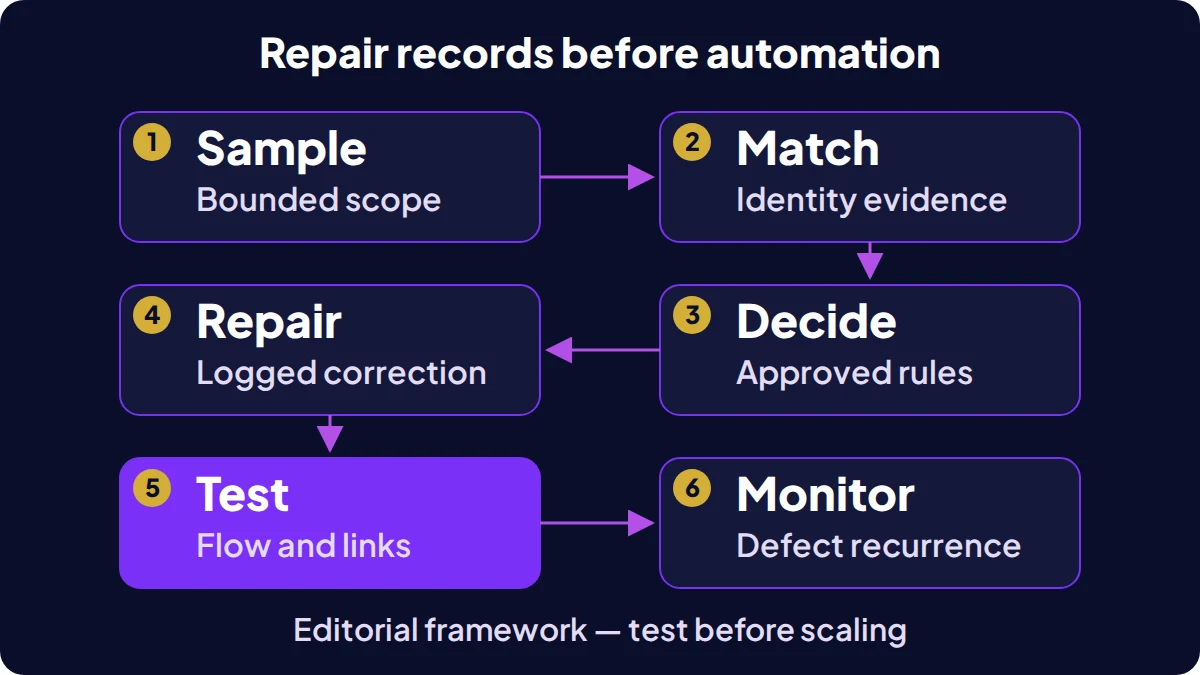
Use these six stages as an editorial operating framework, not a promised project timeline:
- Scope: select an active workflow, responsible owner and authorized sample. Define what remains outside the pilot.
- Baseline: count defects using written rules; separate unknown values, candidate duplicates and confirmed duplicates.
- Decide: approve identity matching, field precedence, stage evidence and next-action requirements.
- Repair: correct records with recorded reasons; investigate ambiguous cases rather than bulk guessing.
- Test: replay entry and sync scenarios, inspect linked activities and review queued communication before resuming it.
- Monitor: assign recurring exception review and compare the same defined cohort after repair.
Acceptance should demonstrate that a repeated inquiry reaches the right relationship, distinct projects remain separate, the assigned seller sees the right action, restrictions survive and connected data agrees. Include a known non-duplicate case: a system that merges every similar name can appear efficient while damaging the database.
Measure quality with clear denominators
Choose a small number of operational measures. Each needs a population, counting unit, observation date and owner. Do not add overlapping defect percentages together or present a reviewed sample as a validated whole-site finding.
| Measure | Definition |
|---|---|
| Follow-up completeness | Eligible open opportunities with an owned action or approved waiting review / eligible open opportunities |
| Stage evidence completeness | Reviewed opportunities meeting agreed stage evidence / reviewed opportunities |
| Confirmed duplicate cases | Reviewed identity groups confirmed duplicate; separate from number of records merged |
| Exception resolution time | Elapsed time from logged defect to verified repair, using a defined calendar |
| Recurrence | Previously repaired cases in the tracked cohort where the same defect returns |
Illustrative example: a review finds 24 of 120 eligible open opportunities lack an owned next action or waiting review, so the defect rate is 20%. After repair, 6 of the same 120 still fail the same rule: 5%. This demonstrates improved completeness in that cohort; it is not a Solvarex client result, conversion increase or revenue forecast.
Track actual sales outcomes separately: qualified inquiry, accepted meeting, opportunity and won business. Only attribute a commercial effect when the measurement design and data support it. More complete fields are useful process evidence, not proof of more booked meetings.
What determines CRM cleanup cost and scope?
The work depends on relationship complexity and connected processes, not just row count. Compare proposals using a shared scope rather than a headline fee.
Ask which objects and sources are included, how candidate matches are reviewed, who approves exceptions, which relationships and histories are preserved, and what integration tests are performed. Separate license fees, implementation effort, manual investigation and ongoing stewardship. Agree acceptance evidence and client responsibilities before a fixed quote.
A simple structured import can need less investigation than a smaller database with shared inboxes, bilingual names and conflicting project records. Ask what is excluded: historical archives, unrelated systems, bulk legal-status checks or reconstruction of missing customer conversations may require separate decisions. There is no reliable universal cleanup price or duration without that scope.
Common mistakes and buyer questions
Avoid merging by name alone, overwriting all values with the newest import, closing deals only because of age, guessing missing information, enabling messages during unresolved identity review, or declaring success from fewer records. Each can make the CRM look cleaner without making it more usable.
Should we delete duplicate contacts?
First determine whether they represent the same relationship and inspect linked activities and opportunities. Use the platform's approved consolidation process only after reviewing consequences. Deleting a record is not an interchangeable substitute for a tested merge.
Does matching an email prove a duplicate?
It is a signal to investigate. Shared inboxes, different project inquiries and integration behavior can create legitimate reasons for repeated channels. Confirm identity and object type before consolidation.
How often should we review pipeline data?
Set a cadence by stage, volume and decision risk. Use regular exception review plus checks at important events such as ownership changes or imports. This guide does not prescribe a universal industry interval.
Can AI clean the CRM automatically?
It can assist with candidate identification and suggested corrections where the system supports those functions. Review evidence, permissions, ambiguous matches and irreversible actions. AI-generated values should not become verified facts without an appropriate source.
Is enrichment enough to fix missed follow-ups?
No. A current title or email does not create an accountable next action or validate an opportunity stage. Repair process fields and ownership alongside any necessary enrichment.
Must we replace the CRM?
Not necessarily. First check whether the current system can support the agreed identity, stage, access and integration requirements. Replace it only when a documented gap or business case supports that decision.
Discuss the repair scope with Solvarex
Solvarex's CRM and pipeline product connects contacts, opportunities and sales follow-up; its implementation service addresses the operating setup. Bring a sanitized field list, source map and a few invented examples of the defects you need to resolve. Do not send confidential customer records to start the discussion.
Book a free consultation to discuss the current workflow, supported systems, acceptance criteria and implementation scope. The practical aim is a record your team can act on, with a clear owner and an evidenced next step.
Before using the cleaned pipeline as a revenue forecast, define the buyer evidence, period rules and snapshot policy in our CRM sales forecasting and stage-criteria guide. Clean records support the calculation; they do not establish deal confidence by themselves.