
B2B lead nurturing is a planned way to help a suitable prospect make progress when they are not ready for a sales conversation or purchase. It connects the reason for the delay to useful information, an accountable owner, a review date and a clear route back to sales. It is not a license to keep sending reminders indefinitely.
For teams selling in Saudi Arabia and the GCC, the practical decisions can include Arabic and English buying roles, several stakeholders, project approval dates and different preferred channels. Start with the buyer's stated situation. A relevant follow-up should help them resolve a decision, not simply ask whether they are ready yet.
Key takeaway: put a prospect in nurture only when there is a documented reason, an appropriate contact path and a useful next step. Keep unsuitable, unresponsive and opted-out contacts separate. Return the prospect to sales when new evidence supports a conversation; pause scheduled messages when that conversation begins.
What is lead nurturing, and when should it start?
Nurturing develops an existing relevant relationship between sales conversations. Qualification assesses suitability and readiness. Routing decides who owns the inquiry. A cold outbound sequence introduces an offer to a prospect. These activities can connect, but they should not share one status or one rule set.
A buyer who says “our implementation review is in the next planning cycle” has given a different signal from someone who never replied. A technical manager who needs an integration checklist has a different obstacle from a company outside your supported market. Record the distinction before choosing a workflow.
Zoho's qualification and nurturing guidance separates suitability, needs and purchase readiness, and describes contextual educational content. This guide turns that general distinction into an operating worksheet. The framework and examples below are editorial recommendations, not Solvarex client results or an industry benchmark.
| Situation | Suitable treatment | Evidence to retain |
|---|---|---|
| Suitable, timing deferred | Reason-specific nurture with an agreed review | Buyer-stated timing and useful next step |
| Suitable, question unresolved | Specialist support before generic nurture | Unanswered question and responsible person |
| No response after agreed attempts | A distinct no-response policy | Contact history and allowed next action |
| Outside the offer or supported scope | Disqualify or refer under an approved policy | Clear reason, without guessing intent |
| Active sales conversation or open proposal | Sales-led follow-up | Account owner and next commercial action |
| Opt-out or contact restriction | Stop the affected communication | Suppression status and source of request |
Do not place a lead in a campaign simply because a task is overdue. Resolve the unanswered inquiry first. For ownership and deadlines, use the separate lead routing SLA guide.
Build a reason-based nurture record
“Warm lead” is too vague to guide a message. Use a small structured record that explains what would make the next contact worthwhile. Keep the buyer's words where relevant, but do not collect unnecessary private information.
A working record needs the company and requirement, current owner, language and appropriate channel, reason for deferral, next useful content or task, review date, current sales activity and exit condition. Store whether the timing came from the buyer or is a team estimate. If you do not know the timing, ask a useful clarification rather than inventing a renewal date.
Use this copyable planning worksheet before automation:
| Field | Question to answer | Example, for illustration |
|---|---|---|
| Requirement | What business decision is the buyer considering? | CRM rollout for a sales team |
| Deferral reason | What prevents a conversation now? | Internal scope has not been approved |
| Useful next step | What helps resolve that obstacle? | A short scope and responsibilities checklist |
| Owner | Who monitors replies and changes? | Named account representative with coverage |
| Review event | What makes the next contact appropriate? | Buyer-agreed planning review |
| Sales return | What evidence warrants a conversation? | A request to discuss approved scope |
| Stop condition | What ends or pauses this path? | Reply, active opportunity, opt-out or review decision |
This worksheet is available within the article; it is not an advertised downloadable product. Copy it into your own operating document and adapt the fields to your process. If your records are still inconsistent, address the foundations in the CRM implementation readiness guide first.
Match the content to the buying obstacle
A nurture message earns its place by helping the buyer complete a decision. Avoid sending the same case study, feature list or meeting request to every segment. A request for a technical answer should reach a specialist; a campaign cannot substitute for the answer.
| Buyer obstacle | Helpful material or action | What to avoid |
|---|---|---|
| Scope is unclear | Requirements worksheet and boundary questions | A premature fixed-price promise |
| Several stakeholders need alignment | Concise role-specific decision summary | Adding everyone to the same campaign without context |
| Integration feasibility is unknown | Verified requirements and a specialist discussion | Claiming every system can connect |
| Commercial approval is pending | Transparent cost categories and assumptions | Invented savings or urgency |
| Timing is explicitly later | Relevant information and an agreed review | Repeated “just checking in” messages |
| Existing supplier contract continues | Buyer-led evaluation criteria, if appropriate | Assuming dissatisfaction or a renewal date |
For example, a Saudi professional-services company may be considering CRM implementation but still needs sales and operations to agree record ownership. A useful first follow-up can share the ownership decisions required before migration. Once those decisions are approved, the representative can offer a scope discussion. This is an illustrative situation, not a report about a Solvarex customer.
Use material your team can defend. Describe hypothetical examples as hypothetical. Obtain approval before sharing client cases or private documents, and avoid publishing contact lists, account screenshots or commercial details as proof.
Localize the relationship, not just the message
Arabic and English versions should help the actual buying roles. Record each contact's preferred language and the language of the decision document. A sales conversation in Arabic may still need an English technical checklist for an IT stakeholder. Do not assume language from a name, nationality or city.
Across Saudi Arabia, the UAE and other GCC markets, confirm the buyer's work calendar and time zone rather than applying one regional sending schedule. During a period when the buyer says they are unavailable, adjust the review date. Avoid automatic references to Ramadan, holidays or procurement seasons unless they are accurate and relevant to that relationship.
Agree the channel and purpose. An email containing a requirements summary and a WhatsApp reminder can serve different needs; sending the same pitch through every available channel can create duplication. Channel availability, permissions and platform rules must be checked in the actual account before implementation. This article does not prescribe a legal basis for messaging or promise that a channel is included in every software plan.
Keep the company relationship visible. If several people from one buying group engage, retain their individual roles while coordinating the account-level conversation. A new stakeholder should not receive an automated “welcome” that ignores an existing proposal. Review account and opportunity status before scheduling another touch.
Set cadence from the next decision
There is no universal nurture frequency for every B2B purchase. Choose the interval from the buyer's stated timeline, the usefulness of the next item, the complexity of the decision and the team's ability to respond. Begin with a limited pilot and revise from actual responses and complaints, not an arbitrary message quota.
Illustrative sequence: a buyer has agreed to revisit scope in six weeks. The owner sends a relevant requirements worksheet now, offers clarification if needed, and schedules a review near the agreed date. If the buyer replies earlier, the remaining nurture steps pause. If there is no new information at the review, the owner decides whether to agree a later date, close the path or keep a limited suitable follow-up. Six weeks is an example, not a recommended interval or service commitment.
Set an upper review boundary. A record should not remain enrolled forever because it never reached a score. At review, confirm suitability, data accuracy, communication preferences and whether there is still a useful reason to continue. Preserve “no new evidence” as an outcome rather than treating it as a failed sale.
Avoid silently resetting the clock when a contact is re-imported, a tag changes or the owner moves teams. Retain the enrollment reason, last meaningful interaction and rule version. A new campaign name does not create a new relationship.
Define pause, exit and re-entry before sending
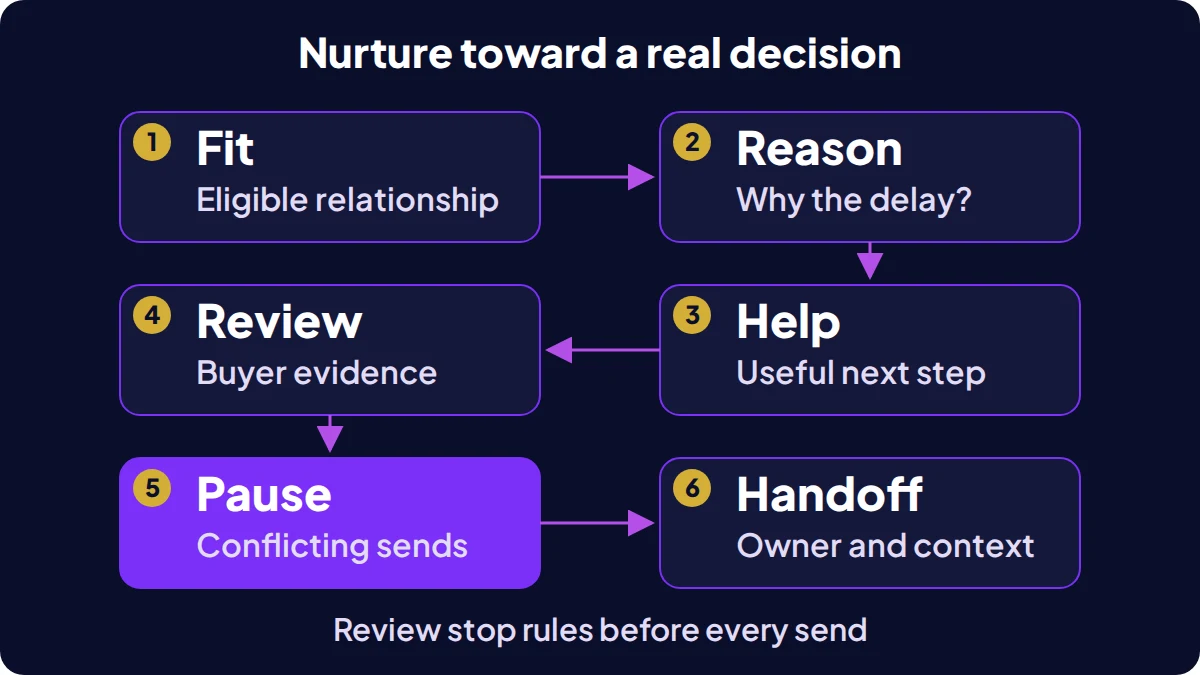
Every automation needs a stop test before a send action, not only an entry test. A buyer can reply, book a discussion or opt out while waiting between steps. The next queued message must reflect the latest state.
A practical control order is: check contact restrictions, active sales activity, recent meaningful reply, current suitability, duplicate enrollment and the next review decision. The exact implementation depends on your tools and integration behavior. Test queued sends, delayed synchronization and conflicting workflows explicitly.
ActiveCampaign's automation settings documentation illustrates why account configuration matters. It documents entry concurrency choices and optional exits on unsubscribe or a tracked conversion. Those product settings are not proof that an ordinary reply automatically stops every workflow, or that other platforms behave the same way. Inspect your configured reply and sales-status handling separately.
For an integration, agree which system owns suppression and opportunity status, which direction updates flow, and what happens when an update fails. A failed synchronization should create a visible exception for a person, rather than quietly enrolling the contact again. Solvarex's workflow design and CRM integration service supports scoping and testing these process connections.
Return to sales on evidence, not a score alone
A scoring model can prioritize review, but it should not manufacture purchase intent. Distinguish a direct request, a buyer-confirmed project change and an observable interaction that still needs interpretation.
| Signal | Recommended decision | Handoff context |
|---|---|---|
| Requests a consultation or proposal discussion | Route for timely human follow-up | Request, requirement, owner and next action |
| Confirms scope or an approval milestone | Requalify with the buyer | What changed and what remains uncertain |
| Asks a technical or commercial question | Assign the appropriate specialist | Question, relevant history and requested answer |
| Clicks a relevant resource | Review context; do not assume readiness | Resource and supporting interaction evidence |
| Only registers an email open | Keep as weak engagement evidence | Tracking limitations and other signals |
HubSpot's bot-filtering documentation explains that marketing email activity can include security scanners and privacy filters such as Apple Mail Privacy Protection. Its filtering removes suspected bot activity from reports. The operational implication is to avoid treating an open or isolated click as a buyer's confirmed intention. This is an interpretation of the documented measurement limitation, not a claim that every click is automated.
A sales handoff should include the original requirement, deferral reason, material shared, latest evidence, current contact preferences and accountable owner. Pause conflicting nurture, create the next action and retain the sales acceptance decision. If sales returns the lead, require a reason and a fresh review decision instead of restarting the old sequence blindly.
Measure qualified progress and the workload it creates
Judge nurture by whether suitable relationships progress into useful conversations and accepted opportunities. Email engagement can help diagnose content, but it should not replace commercial outcomes.
Define the reporting unit before calculating rates: account, contact or requirement. One company with three contacts should not automatically count as three opportunities. Use a defined enrollment cohort and observation period; later sales cannot be attributed to one message without an appropriate measurement design.
Track these measures with explicit denominators:
- Meaningful response rate: enrolled eligible contacts giving a substantive response divided by the eligible contacts observed in the same cohort.
- Sales-accepted return rate: requirements accepted for renewed sales work divided by eligible nurtured requirements in that cohort.
- Held meeting rate: meetings actually held for nurtured requirements divided by eligible requirements observed; report booked slots separately.
- Opportunity progression: accepted opportunities that advance under your documented stage evidence, with age and observation window shown.
- Guardrails: opt-outs, complaints, duplicate messages, overdue review dates and unhandled replies.
Missing timestamps or inconsistent stages belong in a data-quality exception, not a zero-value conversion. An observed improvement is not automatically caused by nurture; acquisition mix, seasonality and sales coverage may also have changed. Compare like cohorts and label any uncertainty.
Pilot the process before buying more automation
Start with one offer and one reason-based group. Name the process owner, sales acceptance owner and technical owner. A small manual pilot can reveal unclear reasons, weak content and missing stop rules before those problems scale.
- Inspect sanitized sample records and separate suitable-later from no-response and out-of-scope situations.
- Agree the worksheet fields, communication path and account-level owner.
- Prepare one useful resource per supported obstacle and a limited review schedule.
- Test a normal journey, an early reply, a booking, an opt-out, duplicate entry and a failed integration.
- Review reply handling, sales acceptance, held meetings and guardrails together.
- Expand only after the process is understandable and the team can maintain it.
Cost depends on the number of segments, localized content, channels, systems, data cleanup, branches and acceptance tests. Separate software subscription, implementation, messaging usage and ongoing ownership. A larger library of emails is not necessarily a more valuable program.
When comparing platforms, ask to see your own entry, pause, suppression and return-to-sales scenarios demonstrated. Check the selected plan and integration requirements using current vendor documentation. The existing ActiveCampaign overview is related reading; the operating policy should remain independent of vendor choice.
Frequently asked questions
How is nurturing different from following up on a proposal?
Nurture supports a suitable relationship before renewed sales readiness. An active proposal belongs to a sales-led process with its own next decision and owner. Keep the two paths coordinated so a buyer does not receive generic campaign messages during negotiation.
Should every lead that does not reply enter nurture?
No. No response does not establish suitability, timing or contact permission. Apply a separate documented no-response policy and review available context before enrolling anyone in a continuing program.
How often should a Saudi or GCC B2B team send nurture messages?
There is no single regional frequency. Base the schedule on the buyer's agreed next decision, preferred channel, local calendar and the value of each contact. Test a limited schedule and monitor responses and guardrails.
Can one workflow serve Arabic and English contacts?
It can if the actual platform supports the required branches and the team tests them. Keep language, content, channel and ownership explicit. Independently review Arabic meaning and layout rather than merely translating subject lines.
Does a high lead score mean the buyer is ready?
No. A score is a prioritization aid built from chosen inputs. Review the underlying evidence and confirm the buyer's situation before declaring sales readiness or creating an opportunity.
What should happen when the buyer replies or books a meeting?
Assign a person, preserve the context and pause irrelevant scheduled nurture. Confirm whether the meeting actually occurs and whether sales accepts the requirement; a booking alone is not a qualified opportunity.
Make the next contact useful
Effective nurturing starts with a defensible reason to continue the relationship and ends with a clear human decision. Give the buyer relevant help, retain the context and make it easy for your team to recognize when the situation changes.
If your suitable leads remain in spreadsheets or receive disconnected reminders, explore Solvarex marketing and follow-up automation and CRM implementation. For managed acquisition and qualification, review the separate B2B lead generation service. Agree the ownership boundary between generating demand and nurturing existing inquiries.
Book a free consultation with Solvarex to discuss the process and implementation scope. Bring a sanitized nurture worksheet, your current stages and example stop rules so the conversation can focus on the decisions that need work.