Published: 4 October 2026. This is a decision framework, not a salary survey, provider price list, or promise of meetings.
Outsourced SDR support and an internal sales-development team can both work. Choose between them by comparing the work required, the management available, and the cost of an accepted sales opportunity—not just a monthly fee against a salary.
For B2B companies targeting Saudi Arabia, the UAE, or other GCC markets, the decision also needs an account-specific language plan, realistic prospect coverage, and a reliable handover to the person who will close the sale. This guide helps founders and sales leaders compare internal, managed, and hybrid execution without assuming that one model is always cheaper or better.
The decision in one minute
- Consider internal SDRs when prospecting is a lasting capability you want to develop, product knowledge is demanding, and a manager can coach the team consistently.
- Consider a managed provider when the scope is defined and you need execution support for research, outreach, qualification, and appointment setting. Verify what the proposal actually includes.
- Consider a hybrid model when you want to retain commercial judgment and customer relationships while delegating specific repeatable tasks.
- Prepare first if the offer, target customer, qualification rules, or closing capacity is unclear. Changing who sends messages will not resolve those gaps.
What does an SDR do—and what remains with sales?
A sales development representative (SDR) works on the early sales process: researching suitable accounts, contacting relevant people, qualifying interest, and arranging the next conversation. The closing representative handles deeper discovery, proposals, negotiation, and the commercial decision. Job boundaries vary, so define responsibilities in writing.
HubSpot's SDR definition describes this early-stage focus. For an operating decision, separate prospecting and qualification from the full sales cycle. A provider that books meetings is not automatically responsible for winning contracts.
If your need is a complete regional prospecting program rather than a staffing comparison, start with our MENA lead-generation strategy and agency-selection guide.
Outsourced SDR vs in-house: what changes?
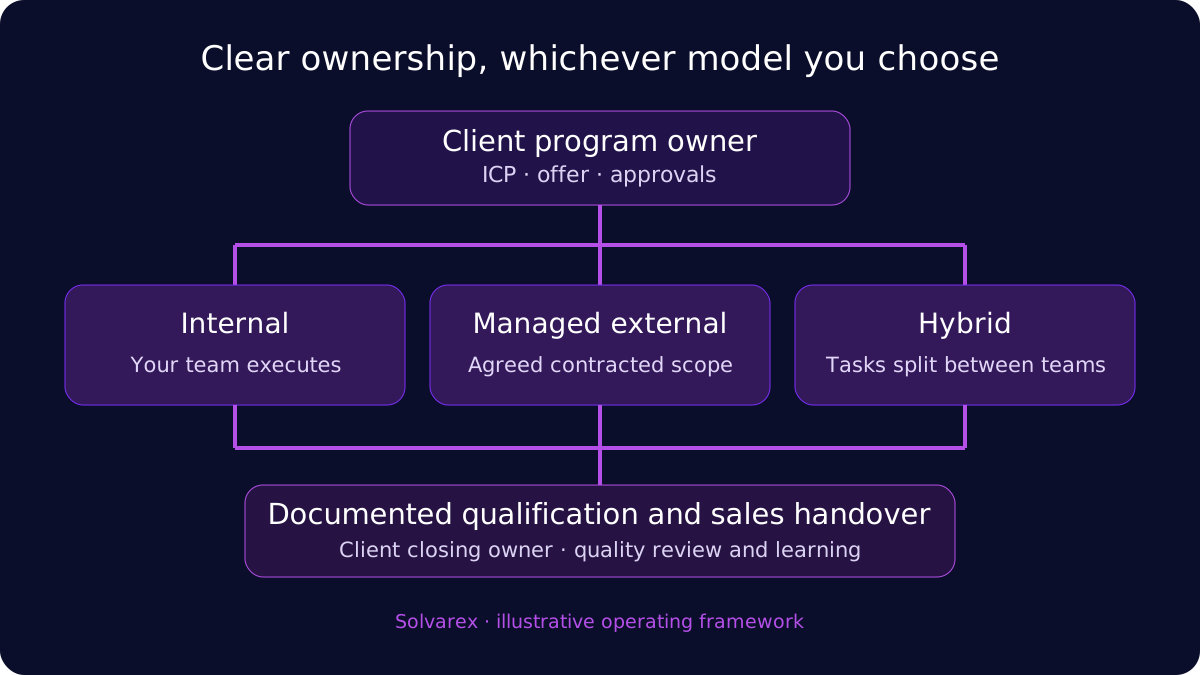
An internal model places the people and daily execution inside your organization. A managed model delegates an agreed scope to an external provider. A hybrid model splits the work deliberately. All three still require someone in your company to own the commercial outcome.
| Decision area | Internal SDR team | Managed external team | Hybrid execution |
|---|---|---|---|
| Daily coaching | Your manager plans and coaches | Confirm the provider's manager and review process | Name one coordinator across both teams |
| Product context | Can develop through close access to colleagues | Requires onboarding, examples, and ongoing feedback | Internal specialist supports external execution |
| Tools and data | You select, administer, and pay for them | Included or additional; check the scope | Specify which party maintains each system |
| Changes in capacity | Depend on hiring and reassignment | Depend on contract terms and actual availability | Shift only tasks with clear interfaces |
| Brand representation | Your team follows your messaging controls | Approve identity, claims, channels, and escalation | Use one approved messaging source |
| Customer information | Keep it in an accessible company system | Define access, export, retention, and exit handover | Use shared rules and avoid duplicate records |
| Long-term learning | Retain coaching and prospect insights internally | Require documented learning and transferable records | Keep commercial learning with your owner |
Treat these as questions to resolve, not automatic advantages. An external fee can exclude tools or management. An internal hire can be effective when the foundations exist, but cannot reasonably be expected to build every missing system alone.
When should you build an internal SDR team?
An internal team is worth evaluating when you have a stable offer, enough suitable accounts, a sustained prospecting need, and someone who can develop the role. It can be particularly useful when conversations require detailed technical judgment or frequent access to product specialists.
Before recruiting, write the role as a weekly workload: account research, outreach, reply handling, qualification, CRM updates, and coaching. Decide who handles infrastructure and data quality. If every task sits with one person, account for the time that person cannot spend talking to prospects.
Ask your manager to review a sample qualification conversation and explain how they would improve it. If coaching is unavailable, a new employee is not a substitute for a sales-development operating model. Consider narrower external support or preparation before committing to headcount.
When should you outsource sales development?
Outsourcing is worth evaluating when you can explain the offer and buyer, agree a bounded scope, and provide timely approvals and sales feedback. It can also help a company test a defined segment without immediately building every execution capability internally.
Request an example of the provider's prospect brief, reporting format, and qualification checklist. Ask who actually researches accounts, speaks with prospects, reviews quality, and handles absence or replacement. Clarify whether resources are dedicated or shared; those arrangements should not be compared as identical capacity.
Avoid choosing a provider because it promises immediate meetings. Launch readiness depends on approved targeting, usable data, infrastructure, messages, and the client's availability. Agree milestones for those inputs before discussing output targets.
How do you compare the full cost?
Compare the same scope over the same period, using your actual payroll assumptions and written provider quotations. There is no universal Saudi or GCC SDR price in this guide.
Internal period cost = compensation and applicable employer costs + recruitment and onboarding + tools and data + allocated management and specialist time.
Managed period cost = provider fees + setup fees + excluded tools or data + allocated client coordination time + other agreed charges.
Include costs once. Allocate shared systems by a reasonable documented method instead of charging the entire company CRM to one SDR. Show cash spending separately from the estimated value of internal time, and mark one-time costs separately from recurring costs. Use the same treatment of tax and currency in both options; obtain appropriate advice for your circumstances.
A worksheet you can use in a proposal review
| Cost line | Internal option: your input | Managed option: your input |
|---|---|---|
| People or provider fee | Compensation and employer costs | Retainer or other agreed fee |
| Initial setup | Recruiting and onboarding | Setup and integration charges |
| Systems | CRM allocation, outreach tools, domains, mailboxes | Only costs excluded from the fee |
| Prospect data | Research, enrichment, verification | Confirm included coverage and extra charges |
| Management | Coaching, reviews, technical support | Client approvals, coordination, sales feedback |
| Coverage gaps | Assumptions for absence, vacancies, and ramp | Availability and replacement terms |
| Exit or transition | Documentation and reassignment effort | Notice, exports, access transfer, extra fees |
Copy the worksheet into your own planning document and fill it with confirmed figures. It is an embedded planning aid; no download or automated calculator is required.
Illustrative arithmetic—not market pricing
Suppose an internal option has a hypothetical monthly total of SAR 24,000, and a managed option has a hypothetical total of SAR 18,000. These are invented planning inputs, not Solvarex prices, Saudi salaries, or client results.
If the internal option produces 12 held meetings that sales accepts against the agreed rules, its cost per accepted meeting is 24,000 ÷ 12 = SAR 2,000. If the managed option produces 8, its equivalent is 18,000 ÷ 8 = SAR 2,250. The lower total is more expensive per accepted meeting in this scenario.
If the managed option instead produces 10 accepted meetings at the same cost, the figure becomes SAR 1,800. This sensitivity test shows why quality and capacity assumptions can change the conclusion. It predicts neither result. With zero accepted meetings, the ratio is undefined; report the cost and zero output rather than dividing by zero.
For a longer evaluation, include setup costs in the chosen period. Then compare sales-accepted opportunities and eventual revenue from matched cohorts. Do not treat hypothetical future bookings as already delivered.
Who owns the work in a hybrid model?
A hybrid arrangement should split responsibilities by task, not leave both teams assuming the other is following up. The table below is a suggested starting point, not a description of every Solvarex engagement.
| Workstream | Suggested accountable owner | Execution and evidence |
|---|---|---|
| ICP, exclusions, offer claims | Client commercial leader | Approved account criteria and message brief |
| Research and enrichment | Named research lead | Sources, validation dates, and duplicate checks |
| Outreach and reply handling | Named campaign lead | Approved sequences, reply routing, suppression |
| Qualification | Named qualification lead | Evidence against agreed criteria; unknowns visible |
| Meeting acceptance | Client sales manager | Accept or reject with a specific reason |
| Discovery, proposals, closing | Client closer | Next action, opportunity status, outcome |
| Reporting and changes | Client program owner | One review covering costs, quality, and learning |
For each row, add the person's name, backup, response expectation, and system of record. A documented handover is more valuable than a diagram showing two teams connected without explaining the transfer.
What makes a meeting worth accepting?
An accepted meeting should satisfy a written qualification standard and have enough context for sales to decide the next step. A calendar invitation alone proves only that an invitation exists.
Use separate states for booked, held, sales accepted, and opportunity created. HubSpot's lifecycle documentation distinguishes sales qualification from the opportunity stage. Your definitions can differ, but they must be consistent across internal and external teams.
Build the prospect brief around account fit, relevant stakeholder, business need, timing, budget status, and the agreed agenda. Salesforce's qualification guidance illustrates recording qualification information in the sales system. Do not invent a budget or decision date to complete a field; mark it unknown and define whether further discovery is required.
Agree how to handle duplicate accounts, existing opportunities, reschedules, no-shows, rejected meetings, and replacement requests. Count one conversation once. Require rejection reasons such as wrong segment or missing need, rather than a blanket statement that the lead was weak.
What should Saudi and GCC teams check before launch?
Local relevance starts with the target account, not assumptions about every buyer in a country. A Saudi industrial supplier and a UAE software provider may need different stakeholders, product evidence, and qualification questions even if both use Arabic and English.
- Select a specific segment. Record industries, company characteristics, locations you can serve, and exclusions.
- Test language capability. Review a real example message and role-play a relevant conversation in the required language. Do not equate an Arabic template with Arabic qualification capability.
- Check buying context. Identify technical users, commercial sponsors, and procurement where relevant; do not assume the first contact is the signatory.
- Confirm timing and coverage. Specify time zones, working hours, meeting availability, and who handles replies outside the agreed window.
- Check channel and data rules. Confirm permitted use, contact sources, access controls, and opt-out handling before outreach. Business contact availability is not universal permission to message.
- Prepare the closing team. Make sure a named owner can take meetings, evaluate fit, and follow up.
For email, review the recipient provider's current requirements. Google's Gmail sender guidelines distinguish requirements for all senders to personal Gmail accounts from additional bulk-sender requirements. Authentication helps establish sender identity; it does not guarantee inbox placement. Keep infrastructure review inside the program scope rather than assuming a messaging tool handles it automatically.
How should you evaluate a pilot?
Agree an evaluation period appropriate to your sales cycle and account pool. Define readiness gates first: approved targeting, tested access, approved messages, qualification rules, and handover ownership. Then review the chain from suitable accounts to conversations, held meetings, accepted meetings, and opportunities.
Report the denominator for every rate. Separate contacts from companies, attempted outreach from delivered messages, and pipeline estimates from won revenue. Compare segments and equivalent cohorts; a new market and an established referral channel are not interchangeable tests.
Use a weekly review to inspect rejection reasons, missing data, repeated objections, and follow-up delays. Decide whether the next change belongs in targeting, the offer, execution, or sales handover. More activity is not automatically the remedy.
Common mistakes that make both models underperform
- Comparing salary with an all-inclusive fee while ignoring different scope.
- Delegating prospecting without retaining a client decision-maker.
- Paying for booked meetings while expecting accepted opportunities.
- Allowing duplicate outreach from internal and external teams.
- Changing qualification rules after delivery without documenting the change.
- Selecting a fixed launch promise before approving the prerequisites.
- Scaling a pilot before checking whether the closing team can follow up.
Where does Solvarex fit?
Solvarex's managed B2B lead-generation and appointment-setting service covers ICP definition, prospect data and infrastructure, Arabic and English outreach, BANT qualification, prospect briefing, and reporting. Review the actual proposal for your markets, responsibilities, deliverables, and service-agreement terms. This article does not establish a dedicated staffing arrangement or a fixed price.
If your team can execute outreach but spends too much time researching, examine B2B contact-data enrichment. If qualified conversations stall after handover, examine CRM and sales automation. Match support to the gap rather than buying a larger program by default.
Frequently asked questions
Is outsourced SDR support always cheaper?
No. Compare full period costs and equivalent accepted outcomes. Exclusions, coordination effort, setup, and meeting quality can change the conclusion. A lower fee alone does not establish a lower cost per opportunity.
Can an external team replace our entire sales department?
Only if that full scope is explicitly agreed and supported. Prospecting and appointment setting are different from technical discovery, proposals, negotiation, and closing. Keep a named closing owner for the arrangement described here.
Should we hire one SDR before we have a sales manager?
First establish who will coach the SDR, approve targeting, and review quality. If that capacity is missing, narrow the role, build the operating foundations, or evaluate managed support. Headcount alone will not supply all those responsibilities.
How do we retain control with a managed provider?
Approve targeting and claims, specify access and exports, maintain a visible system of record, and review qualification evidence. Agree escalation, change, and exit procedures before execution starts.
What is the best model for a Saudi SME?
There is no universal best model. Start with offer clarity, management capacity, product complexity, target coverage, and sales follow-up. Use the comparison and worksheet to evaluate internal, managed, and hybrid options for your actual business.
Make the decision with evidence
Choose the operating model that fits your responsibilities and resources, then measure whether it delivers accepted conversations and usable opportunities. Treat costs, quality, and closing capacity as one decision.
Bring your target market, offer, current team responsibilities, and main execution gap to a free Solvarex consultation. The next step is to discuss a suitable scope, not assume that outsourcing is automatically the answer.
Sources checked 4 October 2026: official HubSpot SDR and lifecycle guidance, Salesforce qualification guidance, Google Gmail sender guidance, and current Solvarex service pages linked above. The worksheets, responsibility matrix, and numerical scenario are original planning examples; they are not proprietary benchmark research.