Key takeaway: Build MENA lead generation around a defined buyer, useful outreach, and a measurable sales handover. Choose a B2B lead generation agency by the quality of its targeting, qualification, reporting, and operating responsibilities—not by a promised contact count.
For a company selling to businesses in Saudi Arabia, the UAE, or the wider region, the immediate challenge is often practical: who should you approach, what should you say, and who owns the next step when someone responds? Buying more software or a larger contact list does not answer those questions.
This guide connects regional prospecting strategy with the decision to run it internally or use a managed provider. It includes an agency evaluation checklist, a cost comparison framework, and a planning example. The frameworks are recommendations from Solvarex, not market benchmarks or reported client results. Updated 4 October 2026.
What is B2B lead generation in MENA?
B2B lead generation in MENA is the process of identifying suitable business accounts in the Middle East and North Africa, engaging relevant people, and developing qualified interest for a sales conversation. A researched contact is a prospect; it becomes a meaningful lead when there is a relevant interaction or expressed interest. A booked meeting still needs qualification and attendance before it can support a credible pipeline forecast.
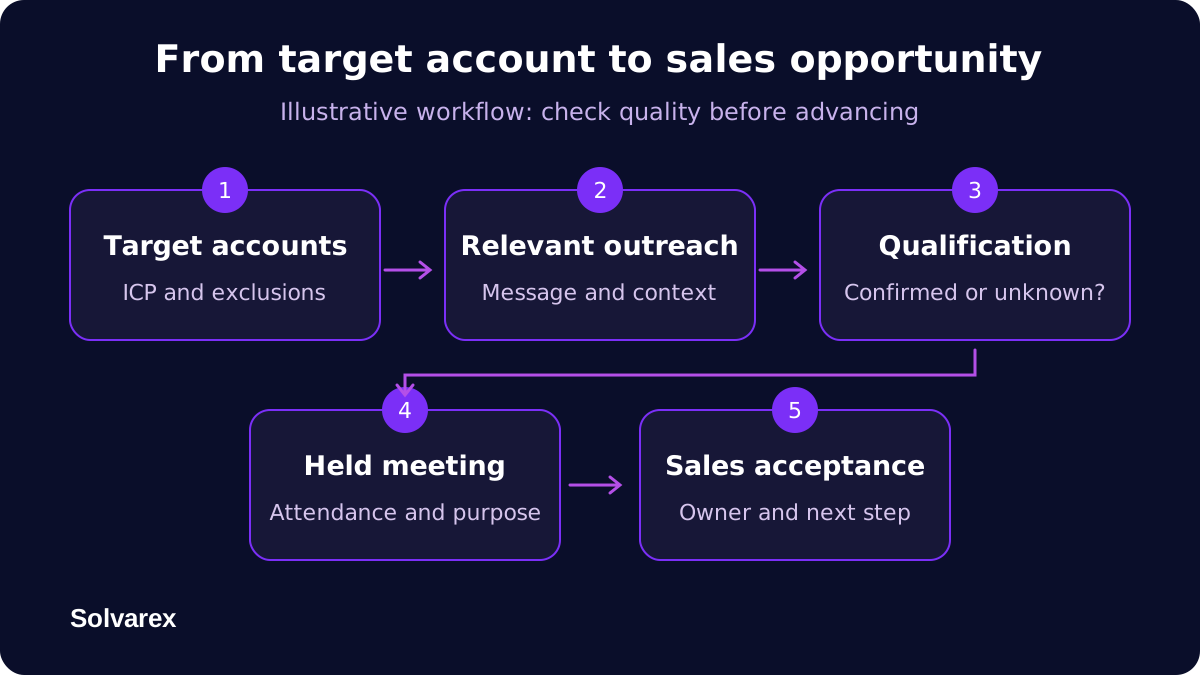
Use distinct stages for researched accounts, engaged contacts, qualified leads, held meetings, accepted opportunities, and customers. The names can vary by CRM. HubSpot's lifecycle-stage documentation similarly distinguishes marketing qualification, sales qualification, and opportunities. Decide what each stage means in your business before comparing channel or agency performance.
MENA is a regional label, not a single targeting segment. Define the countries you can serve, your delivery constraints, and the buyer's language and operating context. Do not assume that a message tested in one country will transfer unchanged to another.
How do you build a regional prospecting strategy?
Start with one commercially credible segment and one offer. Add channels after the target, message, qualification criteria, and sales ownership are clear.
1. Define the ideal customer profile and exclusions
An ideal customer profile, or ICP, describes the companies your offer is designed to serve. Include industry, company size, location, business problem, relevant systems, and an observable reason to engage. Add exclusions such as unsupported countries, an unsuitable project scope, existing customers, and accounts already owned by another salesperson.
For example, a software implementation firm might choose Saudi distributors that need better visibility into sales and stock. That is an illustrative segment, not proof that every distributor needs a particular system. Research the current workflow before asserting a problem in outreach. Separate the company fit from the role fit: a finance leader, operations manager, and IT evaluator may need different explanations of the same offer.
Document your assumptions in a short worksheet: target segment, problem, trigger, relevant roles, exclusions, language, evidence, and next action. If the evidence is weak, validate the segment in conversations before expanding the list. Solvarex's managed B2B data and enrichment service supports ICP definition, list building, enrichment, and cleaning under an agreed scope.
2. Localize by account and buyer
For Saudi Arabia, confirm that you can deliver the proposed service in the relevant location and that the target entity and role match your offer. For UAE prospecting, distinguish a local operating business from a regional headquarters: the person located in Dubai may not own the buying decision for another country. These are research checks, not universal rules about how buyers behave.
For Egypt, Jordan, and other MENA markets, review the same practical questions: which entity buys, who evaluates, what implementation support is available, and which language the buyer uses. Use Arabic or English based on observed preference and context. Avoid inferring language, budget, or purchasing authority from nationality or a job title alone.
Localization also covers calendars, time zones, terminology, references, and the proposed next step. Use examples that match the prospect's business. A service sold through a project proposal needs different qualification from a monthly software subscription.
3. Coordinate outbound, inbound, account outreach, and referrals
Outbound reaches selected accounts through relevant direct contact. Inbound gives researching buyers a useful route through service pages, guides, and consultation forms. Account-based outreach coordinates work around named companies and their stakeholders. Referrals create introductions through credible business relationships.
These approaches can support each other. A prospect who receives an email may inspect your website before replying. A referred buyer may need a clear implementation outline. An inbound inquiry may need qualification rather than an immediate product demo. Assign an owner and track the next step across channels instead of treating every interaction as a separate lead.
4. Protect email quality and respect channel rules
Confirm the sender identity, domain authentication, list quality, and opt-out handling before launch. A verified email address does not guarantee delivery, inbox placement, or permission to contact someone.
Google's Gmail sender guidelines distinguish requirements for all senders from stricter requirements for bulk senders to personal Gmail accounts. Authentication, sending behavior, and recipient feedback matter; passing a technical check is not a guarantee of inbox placement. Review the current requirements applicable to your sending pattern and provider.
Use LinkedIn and other channels within their applicable policies. Do not treat automation as permission to send unwanted messages. Agree which contacts may be approached, how requests to stop are handled, and how suppression carries across tools. For setup and sequence execution, see Solvarex's email and LinkedIn outreach service.
What counts as a qualified B2B meeting?
A qualified meeting is an agreed sales conversation with a relevant person at a suitable account, supported by enough verified context to justify the next step. The qualification definition should be written before the campaign starts.
Solvarex's current managed lead-generation offer uses agreed BANT criteria: budget, authority, need, and timeline. For your own process, record what is confirmed and what remains unknown. An unknown budget should not become a confirmed budget simply because a contact agreed to speak.
| Handover field | What the sales team should receive |
|---|---|
| Account fit | Company, segment, country, and reason it meets the ICP |
| Buyer role | Responsibility and known place in the decision process |
| Business need | The problem described by the prospect, with context |
| Budget and timing | Confirmed information and explicitly marked unknowns |
| Meeting | Agreed purpose, attendees, time zone, and location or link |
| Ownership | Sales owner, next action, and relevant conversation history |
Separate a booked meeting from a held meeting. Define duplicate-account handling, rescheduling, no-shows, and rejection reasons. A held conversation can still be unsuitable; a qualified conversation can still take time to become an opportunity. Track these outcomes separately rather than inflating a single lead total.
How do you choose a B2B lead generation agency in MENA?
Choose a provider whose scope, evidence, and handover process fit your offer and sales capacity. Ask to see how work will be performed and measured, rather than accepting a guarantee of meetings or revenue as evidence of quality.
Use this evaluation checklist when discussing a proposal:
| Evaluation area | Ask the provider | Evidence to request |
|---|---|---|
| Targeting | How will you define and approve our ICP? | Sample account criteria and exclusions |
| Regional execution | How will you adapt by country and buyer language? | Relevant sample messaging and review process |
| Data quality | How are records sourced, checked, and refreshed? | Field definitions, verification date, and handling of unknowns |
| Qualification | What makes a meeting acceptable? | Written criteria and an illustrative handover |
| Brand representation | Who approves messages and handles replies? | Responsibility matrix and escalation rules |
| Reporting | Can we see held meetings and sales acceptance? | Report definitions and CRM fields |
| Ownership | What do we retain if the engagement ends? | Account, domain, content, and export terms |
| Commercial terms | What is included, excluded, or charged separately? | Itemized scope and agreed dispute policy |
Check references when available and obtain permission before using customer stories publicly. Treat an example dashboard as an example unless the provider identifies and substantiates actual results. Regional familiarity is useful, but it does not replace evidence that the provider understands your segment.
If a proposal includes pay-per-meeting pricing, determine whether the charge applies to bookings, held meetings, or sales-accepted meetings. If it includes replacements, read the agreed conditions. Solvarex's service page describes its replacement terms as part of the service agreement; the written scope should govern the engagement.
Should you outsource prospecting or build an internal team?
Outsource when you need defined operational support and can provide a credible offer, timely approvals, and sales follow-up. Build internally when you have the management capacity and repeatable process to support the team. A hybrid model can keep strategy and closing inside the company while a provider manages research and outreach.
| Model | Suitable situation | Responsibility to plan for |
|---|---|---|
| Internal team | You can recruit, coach, and manage the workflow | Management time, systems, training, and continuity |
| Managed provider | You need scoped execution capacity | Approvals, brand oversight, qualification agreement, and closing |
| Hybrid | You retain account strategy and need operational help | Shared CRM rules and clear boundaries between teams |
Outsourcing does not remove the need for a sales owner. If nobody follows up after the meeting, adding more appointments can make the backlog worse. Test whether your team can respond, run discovery, and prepare proposals before increasing campaign activity.
How much does B2B lead generation cost in MENA?
There is no single defensible regional price for B2B lead generation. Cost depends on the target accounts, languages, channels, data work, infrastructure, qualification depth, and reporting requirements. Solvarex scopes service fees separately from software subscriptions; request a quote for the actual program rather than relying on an unsupported market average.
Compare total cost across the same period and output definition. For an internal team, include compensation, recruitment, onboarding, manager time, data, software, and infrastructure. For a provider, include setup, recurring fees, usage charges, separately billed tools, and internal oversight. Confirm contract terms and any taxes or currency treatment with the proposal.
Cost per sales-accepted meeting = total program cost ÷ sales-accepted held meetings.
Illustrative calculation: If a program costs SAR 18,000 and produces 12 sales-accepted held meetings, the cost per accepted meeting is SAR 1,500. If it has 20 bookings but only those 12 accepted meetings, dividing by 20 answers a different question. These figures are arithmetic examples—not Solvarex prices, regional benchmarks, forecasts, or customer outcomes. If there are no accepted meetings, report that result; do not present a meaningful cost-per-meeting figure by dividing by zero.
Which metrics should you review?
Review the progression from target account to revenue, with consistent definitions and a defined reporting period. Useful measures include relevant replies, qualified leads, booked and held meetings, sales-accepted opportunities, pipeline created, and closed business. Keep rejection reasons visible so you can improve targeting or qualification.
Record both original source and later supporting touches where your systems allow it. Deduplicate accounts and opportunities across email, LinkedIn, referrals, organic search, and AI-assisted discovery. A buyer saying they found you through an AI tool is useful evidence; an unidentified website visit is not proof of an AI recommendation.
For organic and AI visibility, distinguish impressions, visits, inquiries, and accepted opportunities. Google's guidance on AI search features emphasizes established SEO practices; useful content and technical eligibility do not guarantee inclusion. Ask relevant buyers how they discovered you and verify recorded referrals before making claims about citations.
What should a 90-day launch plan include?
Use a phased plan with readiness checks rather than a promise of fixed results. The following is a suggested planning structure; the actual schedule depends on approvals, account access, offer complexity, and buyer response.
- Foundation: Agree the ICP, exclusions, qualification definition, ownership, data requirements, channels, and approved messages. Check sender setup and CRM access.
- Controlled launch: Start with a reviewed segment. Inspect replies, objections, data issues, opt-outs, and meeting handovers. Fix operational problems before expanding activity.
- Refinement: Compare segment and message performance. Review held meetings with sales, adjust qualification, and improve the website content used during outreach.
- Scale decision: Increase investment only when there is evidence of relevant engagement and enough sales capacity. Keep reviewing revenue progression because meetings alone do not establish commercial success.
Stop or revise a sequence when feedback shows poor fit. Agree the review cadence and who can pause a campaign. These decisions make the program easier to manage even when results differ from initial expectations.
Common mistakes to avoid
Buying a large list before defining the buyer creates avoidable research and follow-up work. Sending the same message to every role hides the relevance of the offer. Promoting activity counts without sales acceptance makes weak results look strong. Buying overlapping tools before deciding the workflow adds cost without assigning responsibility.
Other mistakes include unsupported claims in outreach, duplicate contact across teams, missing opt-out handling, and handing meetings to sales without context. Use an agreed checklist and a regular review to find the specific issue rather than replacing the whole system each time performance disappoints.
How can Solvarex support the program?
Solvarex's managed B2B lead generation service covers ICP definition, prospect research, Arabic and English outreach, qualification, appointment setting, and reporting within an agreed scope. Related CRM and pipeline capabilities connect the contact history with ownership and the next action. Choose the combination around the work your team needs help completing.
To prepare for a discussion, bring your target markets, main offer, suitable account examples, current sales process, and definition of a useful meeting. Book a free consultation to discuss the fit and scope. This is a consultation invitation, not a promise of a specific pipeline result.
Frequently asked questions
Is a contact list the same as lead generation?
No. A list provides prospect records. Lead generation connects suitable prospects with engagement, qualification, and a sales next step. Buying records alone does not establish interest or purchasing intent.
Is Arabic outreach necessary for every MENA campaign?
Choose the language by buyer context and observed preference. Prepare natural Arabic and English when the target accounts need both; do not assume everyone in a country prefers the same language.
Can an agency guarantee qualified leads or sales?
An agreement can define deliverables and remedies, but buyer response and purchases depend on factors beyond campaign activity. Assess the qualification definition, scope, and evidence behind any claim. Solvarex does not promise a fixed result in this guide.
What should we ask before signing a lead-generation proposal?
Ask who owns targeting, data, approvals, sending accounts, replies, qualification, meeting follow-up, and reporting. Confirm the output being billed and what happens with duplicates, no-shows, rejected meetings, or termination.
How do we start generating B2B leads in Saudi Arabia?
Begin with a specific segment you can serve, map relevant buyers, validate the need, and agree messages and qualification criteria. Then connect appropriate outreach with a CRM owner and a clear next step. Expand based on evidence rather than a predetermined contact quota.
Sources and next step
Sources checked on 4 October 2026: Gmail sender guidelines, HubSpot lifecycle stages, and Google Search guidance on AI features. Vendor requirements can change; review the relevant official documentation when implementing.
The practical next step is to agree the buyer, qualification standard, and handover before purchasing more activity. If you are deciding who should execute prospecting, use our outsourced SDR vs in-house comparison to evaluate full costs and responsibilities. For broader channel ideas, read our B2B lead-generation strategies and tools guide. For help defining an appropriate managed program, talk to Solvarex in a free consultation.