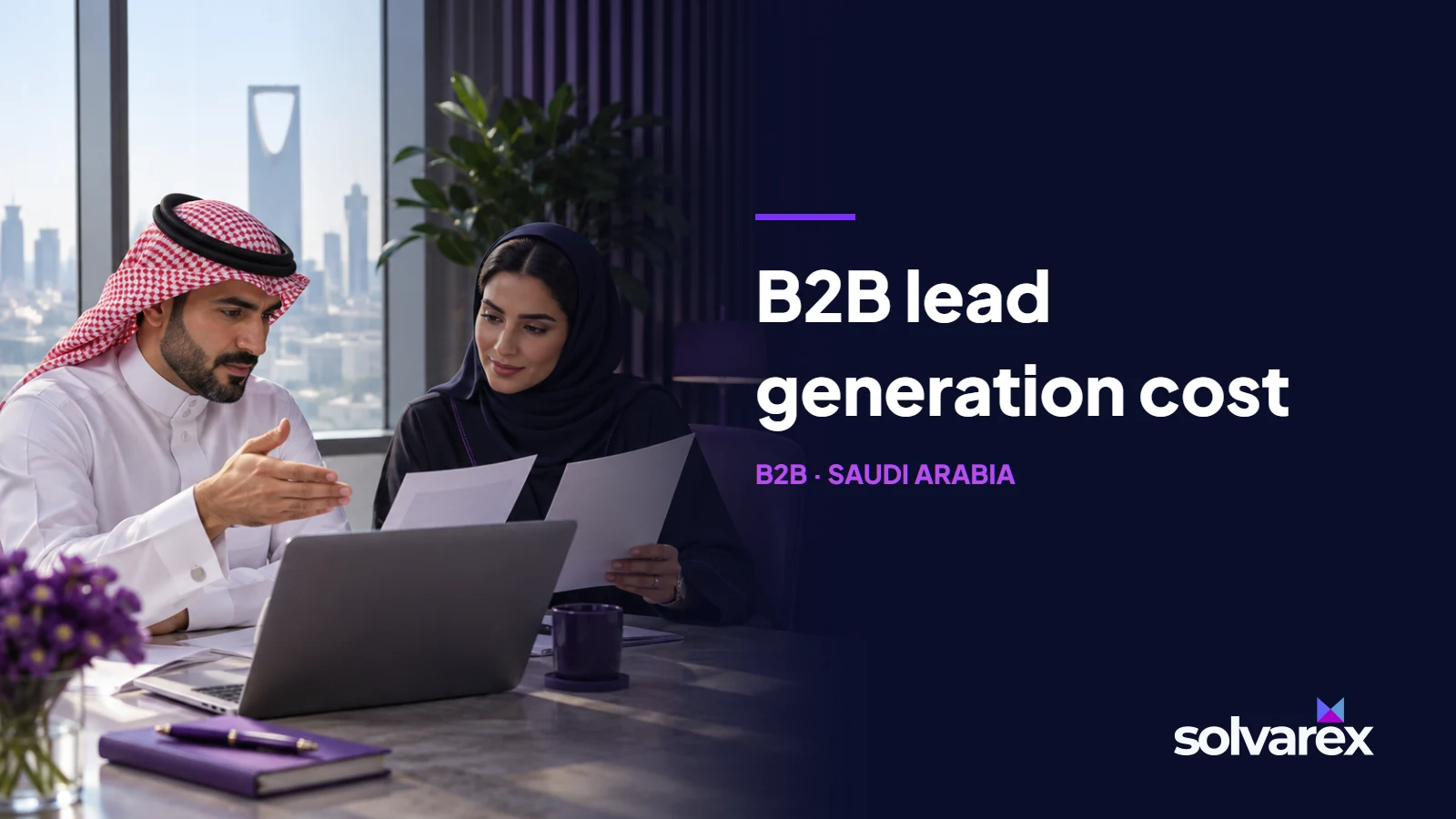
A B2B lead generation quote in Saudi Arabia is only comparable once you know what the supplier will deliver, which costs are included and which sales outcomes count. Start with the total cost in Saudi riyals for a defined period, then divide it by the number of qualified leads, held meetings or accepted opportunities from that same cohort. Use the denominator that matches the decision you need to make.
Buyer takeaway: Ask each supplier to price the same target market and qualification rules. Then compare cost per held meeting and cost per accepted opportunity alongside the invoice amount. Keep the original volumes and counts visible so a small sample cannot masquerade as a reliable forecast.
What exactly are you buying?
A researched contact, an interested reply, a qualified lead, a booked appointment and an opportunity are different deliverables. A verified email address can help a team reach someone. It provides no evidence that the account has a problem you can solve or wants to meet.
| Stage | What qualifies for the count | What to retain in the CRM |
|---|---|---|
| Qualified lead | An eligible account and relevant contact with evidence that meets agreed qualification criteria | Account, role, source, fit, interest and missing information |
| Booked meeting | An invitation to an agreed discovery meeting with an eligible prospect | Invite, intended participants, date and booking status |
| Held qualified meeting | A meeting took place and met the agreed participant and discussion criteria | Attendance, discussion summary and disqualification reason if applicable |
| Accepted opportunity | The sales owner reviewed the handoff and opened or accepted an opportunity using agreed evidence | Acceptance date, stage, owner and next step |
Agree on what a decision maker, influencer or technical evaluator means for your offer. In a Saudi enterprise software sale, a technical lead may be an excellent first meeting participant even if procurement and budget approval come later. For an industrial maintenance contract, site responsibilities and the account’s service footprint may matter more than a senior job title. Record unknowns explicitly rather than assuming all the qualification fields are confirmed.
Build a like-for-like cost comparison
- Define a cohort. Use accounts first contacted during a fixed window. Set a reasonable follow-up date before comparing opportunity outcomes. A meeting from last month that becomes an opportunity this month belongs to its original cohort when calculating acquisition efficiency.
- Reconcile costs. Add the supplier fee, one-off setup allocated to the chosen period, data and tools paid separately, and internal time your team will need to perform the agreed handoffs. Keep the allocation rule consistent. Ask finance to confirm the tax basis and use the same treatment in both quotes.
- Deduplicate the outcomes. A reschedule belongs to the original appointment. Two contacts from one account may represent one opportunity. Use stable CRM IDs and define an exception for genuinely separate buying projects.
- Choose comparable denominators. Divide the total cost by qualified leads, held qualified meetings and accepted opportunities separately. If no opportunity has matured, display its count and mark the unit cost unavailable. Keep the volume beside every ratio.
- Write the acceptance rules. Agree how cancellations, no-shows, duplicate accounts, ineligible regions and disputed qualifications affect invoices and reporting. Give your sales team a practical period to accept or reject handoffs with a reason.
This is the same basic cost-per-outcome arithmetic used in conversion reporting. The definition of the outcome is the buyer’s responsibility here. Google Ads explains cost per conversion.
Worked example in Saudi riyals
These numbers are illustrative. They represent neither Solvarex quotes nor market benchmarks. Both suppliers target the same account segment and the same pilot window. Total cost includes external and allocated internal costs.
| Pilot result | Supplier A | Supplier B |
|---|---|---|
| Total cost | SAR 18,000 | SAR 24,000 |
| Qualified leads | 40 | 36 |
| Booked meetings | 24 | 20 |
| Held qualified meetings | 12 | 16 |
| Accepted opportunities | 3 | 6 |
| Cost per qualified lead | SAR 450 | SAR 667 |
| Cost per held meeting | SAR 1,500 | SAR 1,500 |
| Cost per accepted opportunity | SAR 6,000 | SAR 4,000 |
Supplier A has the lower invoice and the lower cost per qualified lead. Both cost the same per held meeting. Supplier B has the lower cost per accepted opportunity in this cohort because more meetings became accepted opportunities. If only four of B’s six opportunities meet the final acceptance rule, its cost rises to SAR 6,000 and the apparent advantage disappears. The decision depends on reviewing the opportunity evidence and the cost of any extra work your team must absorb.
Before committing, run a second scenario using a conservative attendance rate and acceptance rate. With 20 booked meetings, 60% attendance and 25% acceptance among held meetings, you get 12 held meetings and three accepted opportunities. A SAR 24,000 total would imply SAR 8,000 per opportunity in that scenario. Treat the assumptions as planning inputs and replace them with observed cohort results after the pilot.
Compare fixed, performance and hybrid quotes
A fixed fee can cover research, messaging, outreach, qualification and reporting as one operating scope. Ask for the breakdown of what is included and the deliverables your team must still own. If setup dominates month one, show that month separately and compare later months using the same setup allocation.
A performance fee links billing to a defined unit. One provider in this market advertises pricing around a qualified appointment, illustrating why the event definition belongs in your contract. Ask if a scheduled appointment, actual attendance or sales acceptance triggers payment, and what happens if the account was already active in your pipeline. Example provider offer.
A hybrid quote combines an operating fee with a variable component. Ask for low, expected and high invoice scenarios using the same assumptions. Put an approval limit on variable charges and clarify whether credits reduce the current invoice or apply later.
Prepare a pilot that sales can actually evaluate
For a Saudi IT services provider, the brief might target mid-market accounts with an active infrastructure project and require a relevant IT owner in the first meeting. Include Arabic and English messaging where the buyer context calls for each. For a facilities supplier, segment by operating site and the people who own service procurement. Use those requirements to reject ineligible accounts consistently across both suppliers. These are examples of briefs, not client results.
Before kickoff, share a target-account sample and an exclusion list. Confirm which channels and languages the supplier will operate, which tools you pay for, how they record the source, and who handles responses and follow-up. Agree that sales will review every handoff with a small set of rejection reasons such as wrong account, duplicate opportunity, unclear need or missing participant. That feedback lets you tell whether weak conversion came from targeting, attendance or sales follow-up.
Give sales time to review opportunities before declaring a winner. Compare the same maturity across cohorts and report cost alongside the volume and the accounts behind it. The lowest unit cost can still be a poor decision when the supplier cannot deliver enough relevant opportunities for your available sales capacity.
Questions buyers ask
What is a good cost per lead for a Saudi B2B campaign?
Set a ceiling using your own economics. For example, if your business can spend SAR 20,000 to acquire a new customer and one in five accepted opportunities becomes a customer in a comparable, mature cohort, the implied ceiling is SAR 4,000 per accepted opportunity before allowing for any other acquisition costs. Use a conservative assumption when you have limited history.
Should no-shows count as qualified meetings?
Track them as bookings and give them a separate attendance status. Whether they are billable depends on the contract. For cost per held meeting, include only meetings that actually happened and satisfied the defined criteria.
Can a cheaper lead list beat a managed service?
Compare the cost through the stage you need. Add the work required to contact, qualify and book the list before comparing it with a managed program that covers those steps. Check what remains with your sales team under each quote.
Discuss the scope with Solvarex
Bring a target segment, a sample quote and your current handoff definition to a free consultation. Solvarex’s managed B2B lead generation service covers agreed targeting, outreach, qualification and meeting handoff. If you are still deciding who should own that work, read the in-house versus managed SDR comparison first.